- Borrow a telescope, astrophotography rig, mount, or accessory kit for up to three months.
- Visual Telescopes
- Computerized GoTo Schmidt Cassegrain Telescopes (Visual + Planetary/Lunar Photography)
- Astrophotography Equipment (Deep Sky Photography)
- Eyepiece Kits
- Miscellaneous Equipment
- Current Inventory Status
Borrow a telescope, astrophotography rig, mount, or accessory kit for up to three months.
A benefit of SDAA Full Contributing Membership is access to SDAA loaner equipment. The SDAA maintains a comprehensive fleet of telescopes, mounts, eyepieces, and other accessories that Full Contributing Members are eligible to borrow in three-month stretches.
If you are interested in borrowing some equipment, you can e-mail the SDAA Loaner Equipment Coordinator. You can also review the table at the bottom of the page showing current availability.
Borrowing equipment requires that members follow these steps (see additional details in the Loaner Scope Procedures).
- Contact the SDAA Loaner Equipment Coordinator to verify eligibility and equipment availability. If you are not sure what equipment is right for you, the Coordinator will help you decide.
- Meet the Coordinator at the SDAA Miramar storage facility. Exchange events are scheduled around once per month, so be sure you reach out several weeks ahead of when you need the equipment.
- At the exchange event, the Coordinator will train you in operation of the loaner equipment.
- Members are encouraged to take loaner equipment to Tierra Del Sol to use it under dark skies. Loans are for three months.
- Plan to meet the Coordinator at the SDAA Miramar storage facility when your equipment is due to be returned. Equipment returns take place at the same exchange events as pickups. The Coordinator will inspect the equipment for any damage and check the equipment back into inventory.
Visual Telescopes
The telescopes in this section are meant exclusively for visual use, not for astrophotography. Most use a Dobsonian style mount. The Dobsonian Telescope is a Newtonian reflecting telescope (mirror in the back, eyepiece in the front) mounted on a simple up-down-left-right mount that you move by hand. These telescopes are hugely popular for beginners all the way to advanced amateur astronomers as they prioritize high quality and large aperture optics over complex and fussy electronics and motorized mounts.
The SDAA has numerous visual telescopes available, from compact table-top models that can be carried in a backpack, to popular 8, 10, and 12 inch models. Larger telescopes deliver brighter and higher resolution views, but are heavier and bulkier to move around.

SDAA-041 – 12″ GOTO Dobsonian
SkyWatcher FlexTube 300P SynScan GOTO Dobsonian
This 12” telescope optical tube collapses down to just a little over 36”, allowing you to transport the scope in a majority of vehicles. The large 12” f/4.9 mirror collects over twice the amount of light as an 8″ scope and has 50% higher resolution. This is a GOTO Dobosnian with drive motors on both axes. The SynScan AZ hand control allows you to select an object and the telescope will slew to it automatically and track it across the sky. Dual encoders allow the telescope to be moved manually with no need for re-alignment.
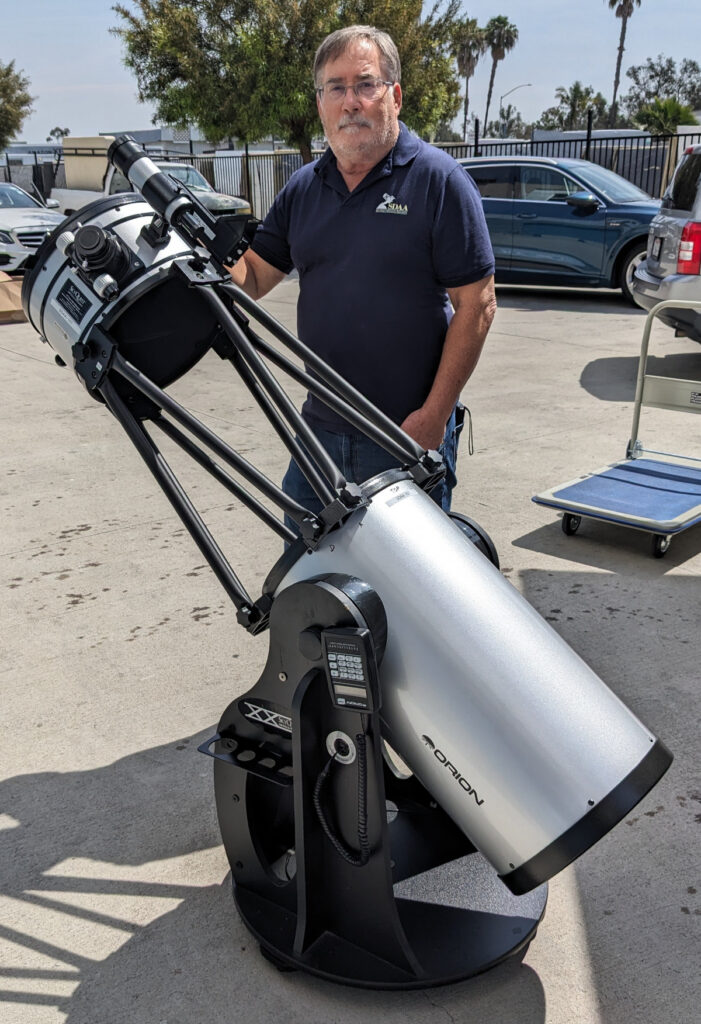
SDAA-107 – 12″ Push-To Dobsonian
Orion XX12i IntelliScope Truss-Tube Dobsonian
Orion’s IntelliScope “Push-To” system comes to a full 12 inches of aperture in this impressively capable light bucket. Like the XT10i below, the IntelliScope system guides you to objects by telling you which direction to push the scope — no motors, no gears, no re-alignment needed if you bump the tube. Just configure, align, dial in your target, and push. The result is a telescope that can precisely locate thousands of objects while remaining simpler and more reliable than a motorized GOTO scope.
What sets the XX12i apart from its smaller siblings is the truss-tube design: the open tube framework collapses down for transport, making this 12″ scope manageable in a wider range of vehicles than a traditional solid-tube design of the same aperture. The 305mm f/4.9 primary mirror collects over twice the light of an 8″ scope, bringing faint nebulae, galaxy structure, and globular clusters to life. Includes a 2″ Crayford focuser.
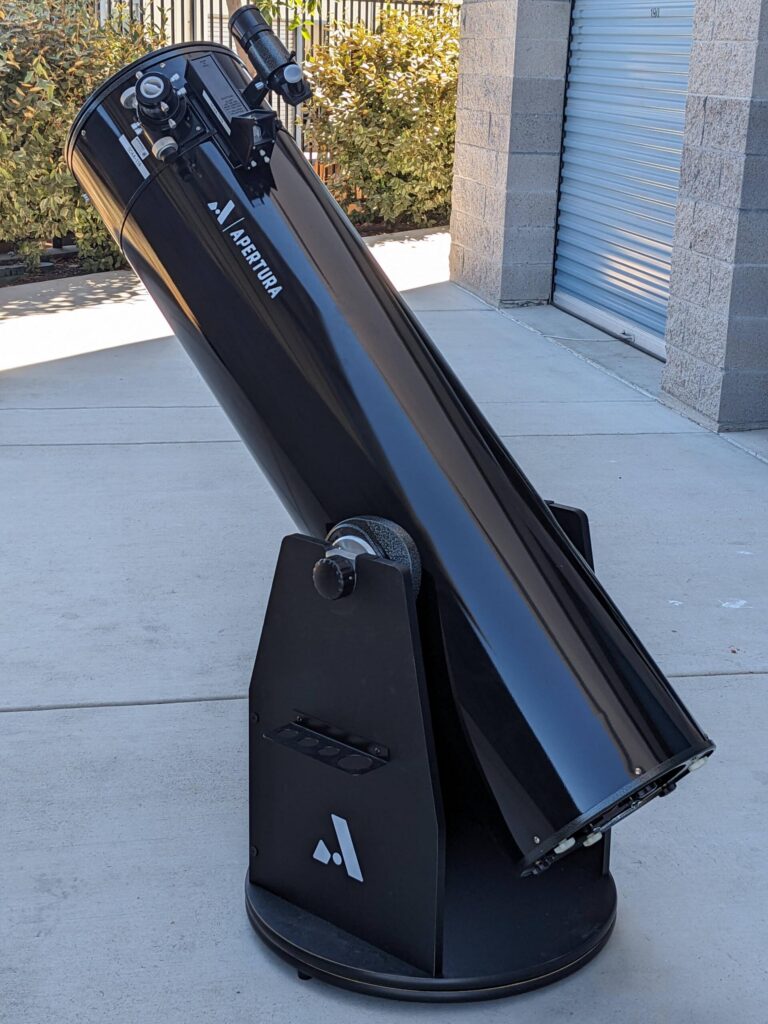
SDAA-119 – 12″ Manual Dobsonian
Apertura AD12
Apertura’s AD12 is a solid-tube 12″ f/4.9 Newtonian reflector on a simple, sturdy Dobsonian mount — no motors, no electronics, just point and observe. The 305mm parabolic primary mirror, figured to 1/12th wave and coated for 93% reflectivity, gathers over twice the light of an 8″ scope, bringing out fine detail in galaxies, nebulae, star clusters, and planets alike. The rigid steel optical tube holds collimation well and includes a machined aluminum 2″ dual-speed 10:1 Crayford focuser for precise focusing, plus a spring-loaded three-point mirror cell. Being the largest scope in the AD series, it’s noticeably heavier and bulkier than the AD8/AD10, so it’s best suited to members with a larger vehicle, but it rewards that extra effort with serious light-gathering power for deep-sky observing under dark skies.
SDAA-084 – 10″ Push-To Dobsonian
Orion XT10i Intelliscope Dobsonian
Orion’s unique “Push-To” Intelliscope system is featured on this 10″ light bucket telescope. The Intelliscope system, once configured and aligned, guides you to objects in the sky, by telling you which direction to push the scope (hence “Push”-To guidance). This makes the telescope simpler, more affordable, and more reliable (no pesky motors or gears to wear out and break) while retaining the ability to precisely locate virtually any object in the sky using an easy-to-use hand control.


SDAA-023, SDAA-033 – 10″ Manual Dobsonian
Enjoy one of our big 10 inch “light bucket” dobsonians under the dark skies of TDS. This telescope is a great introduction to “big scopes”, including a 2″ focuser for those big wide-angle eyepieces. 1200mm f/4.7 optics, 2″ focuser, and a Telrad.
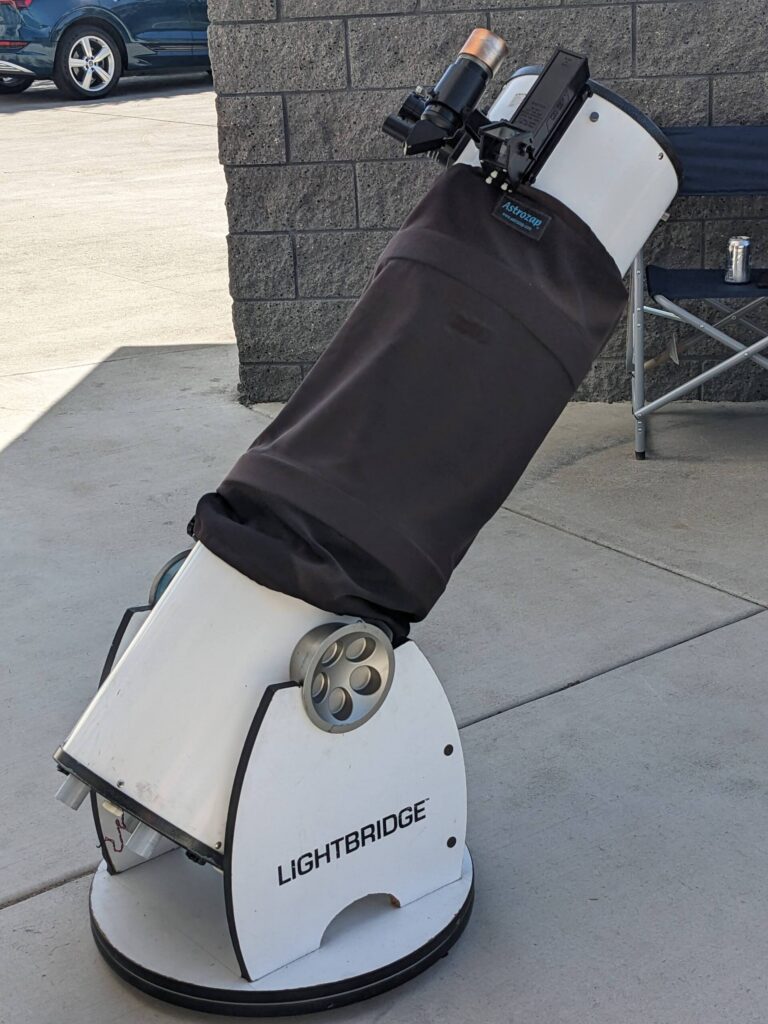
SDAA-120 – 10″ Manual Dobsonian
10″ Meade Lightbridge
This road-ready light bucket is a truss-tube construction, so it can be broken down into smaller pieces to fit in smaller vehicles. But it doesn’t sacrifice aperture: a full 10″ aperture for digging into those faint fuzzies.
Includes a 2″ focuser, 50mm right angle finder scope, Telrad, and an Astrozap shroud.

SDAA-026, SDAA-031, SDAA-042, SDAA-083 – 8″ manual Dobsonian
Zhumell 8″ Dobsonian / Orion SkyQuest XT8
These 8″ telescopes have an 8” parabolic primary mirror with a f/6 focal ratio and 1200mm focal length. Includes a 2″ focuser and a Telrad. This size Dobsonian scope is small enough to pack in compact vehicles, but large enough to observe the entire Messier and Caldwell catalogs.
SDAA-028 – 8″ manual Dobsonian
Bushnell Voyager 8″ Dobsonian
Easy to set up and easy to transport, the Bushnell Voyager features an 8″ parabolic mirror with a f/6 focal ratio and 1200mm focal length, with a 1.25″ focuser. This is a great scope to borrow if you have kids who want to learn to use a telescope. It is rugged and super simple to use.


SDAA-089 – 6″ achromatic refractor on motorized non-goto equatorial mount
Ever wonder what it’s like observing with a really big refractor? This kit is for you! Refractors, with their unobstructed aperture, deliver the sharpest, most pinpoint stars that you can get. But many refractors have rather small apertures, which limits their resolving power and ability to observe faint DSOs. This Celestron C6-R is a great compromise. With 6″ clear aperture, it can reach deep into the Messier and Caldwell catalogs, all while delivering tack-sharp stars across the field. The 150mm aperture, f/8 (1200mm focal length) optical tube is mounted on a beefy Orion Atlas EQ mount. This mount has motor drives, so the RA axis tracks at the sidereal rate, and there is a hand control for fine pointing adjustments in RA and Dec. But there is no GOTO system; you use the clutches and your hands (and a provided Telrad) to point the telescope manually.
Due to the f/8 (rather slow) achromatic optics (color fringing on bright subjects) and lack of GOTO or computer control, this setup is unsuitable for astrophotography. But it’s marvelous for visual work, and is especially nice for globular and open star clusters, and for double stars.
Includes Celestron C6-R f/8 optical tube, Telrad, 2″ diagonal, Orion Atlas EQ mount, and two counterweights.
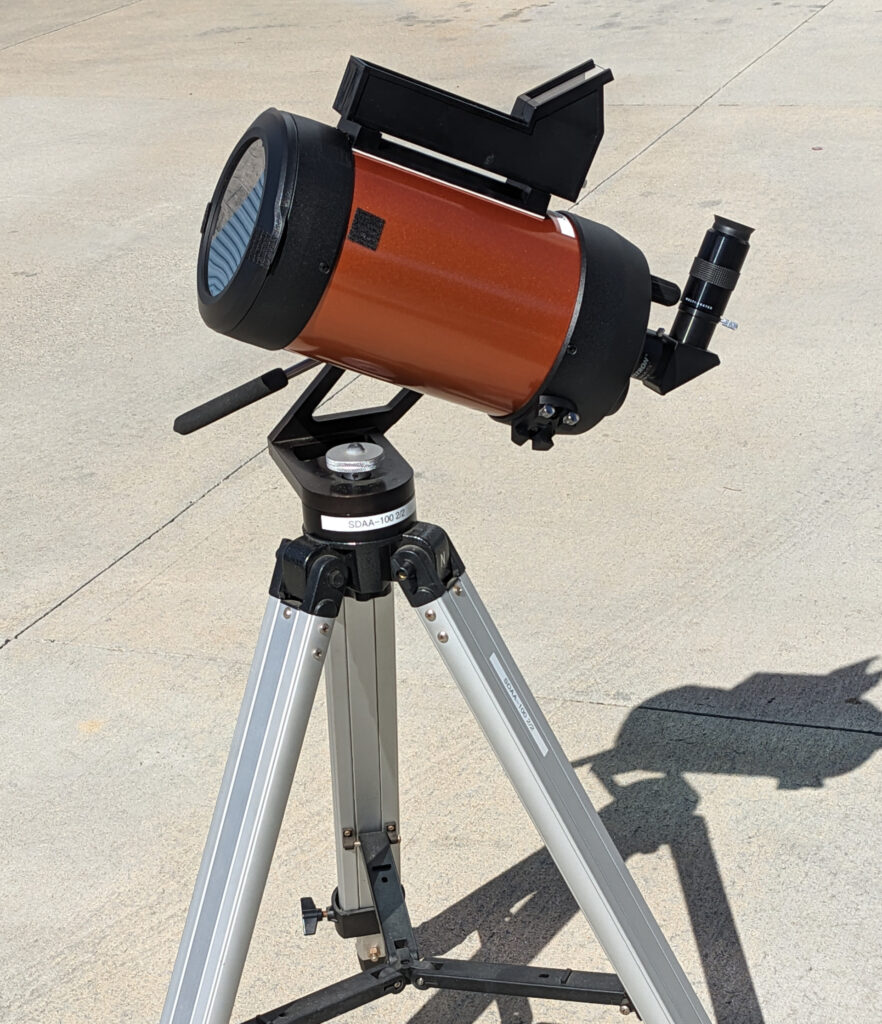
SDAA-100 – 6″ manual Schmidt Cassegrain (SCT)
Very similar to SDAA-076, this is a lightweight, medium aperture telescope riding on a manual alt-az single-fork mount. The mount is an Orion VersaGo, which features precision machined all-metal construction, with big tension adjustment knobs on the altitude and azimuth axes, for buttery smooth movement in any direction.
The optical tube is a Celestron C6: big enough aperture to observe the whole Messier and Caldwell catalogs, but small and compact enough to pack in even the smallest vehicles.
Includes the tripod, mount, C6 optical tube, 1.25″ star diagonal, Telrad, and a full-aperture solar filter for observing the sun.
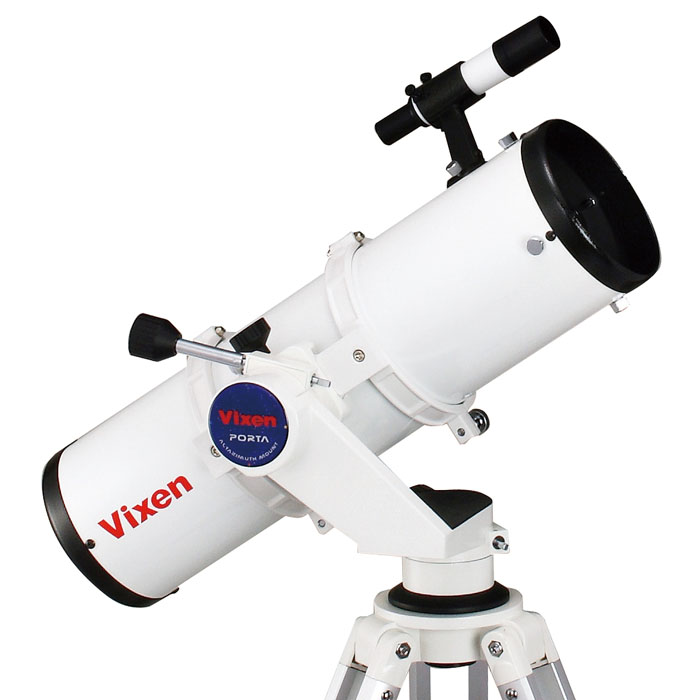
SDAA-076 – 5″ manual alt-az Newtonian
Featuring excellent rigidity, stability, and portability, the popular Vixen PORTA II alt-azimuth mount is paired with with a premium Japanese 130mm f/5 Newtonian reflector. The PORTA II mount is a manual alt-az mount featuring a sturdy aluminum tripod and slow-motion control on both axes for precise pointing at any object in the sky. When broken down into separate pieces (OTA, tripod+mount, accessory box) each component weighs less than 15 pounds and are easy to stow in even the smallest vehicles.
Includes the Vixen PORTA II mount, Vixen R130Sf Newtonian reflector, 20mm finder scope, and a 90 degree adapter allowing attachment of cameras or our SDAA-034 and SDAA-037 Coronado Personal Solar Telescopes in place of the R130Sf optical tube.
SDAA-030 – 5″ manual Dobsonian
The OneSky telescope from Astronomers Without Borders features a 130mm paraboloidal f/5 mirror. With a truss tube that collapses to 14.5 inches in seconds and a total weight of just 14 pounds, performance and convenience are combined in one portable package. This telescope is compact and lightweight so it’s really easy to take out and use any time there is a clear sky. Take this scope camping! The 5 inch aperture is big enough to observe hundreds of deep sky objects from dark skies. Very easy to use: great for getting kids introduced to telescopes. Features a simple helical focuser and red dot finder.

Computerized GoTo Schmidt Cassegrain Telescopes
(Visual + Planetary/Lunar Photography)
These telescopes are Schmidt Cassegrain optical tubes riding on motorized and computerized “GoTo” mounts. Power up the mount, perform a guided alignment routine, and then all you need to do is punch in the catalog ID of the object you want to observe. The mount will automatically slew to the object and once located, track it across the sky.
These telescope systems are primarily intended for visual use, but some limited astrophotography using video captures of planets and the moon, is possible with these telescopes.
SDAA-110
8″ Celestron 8SE with StarSense AutoAlign
This turn-key visual observing platform delivers a generous 8″ telescope aperture with a big 2″ diagonal for wide field views. The Celestron SE single-arm mount is compact but sturdy: easy to pack away in a small car. The whole mount+OTA combination fits in a single padded carrying case for ease of transport.
The real star of this item is the StarSense AutoAlign. This is a dedicated camera and embedded computer that takes photos of the sky, then uses plate-solving to derive what direction the telescope is pointing at all times. It uses this information for precise GOTO (it’s not a photographic camera). Setting up this scope is dead-simple: level the tripod, mount the telescope, point it at the horizon, power up the mount, and select the auto-align feature. After about 5 minutes the telescope is automatically aligned and calibrated, and ready to slew to any of the thousands of objects stored in its memory.
Comes with a 12V wall supply, padded carrying case, and instruction booklet for the StarSense system.

SDAA-082
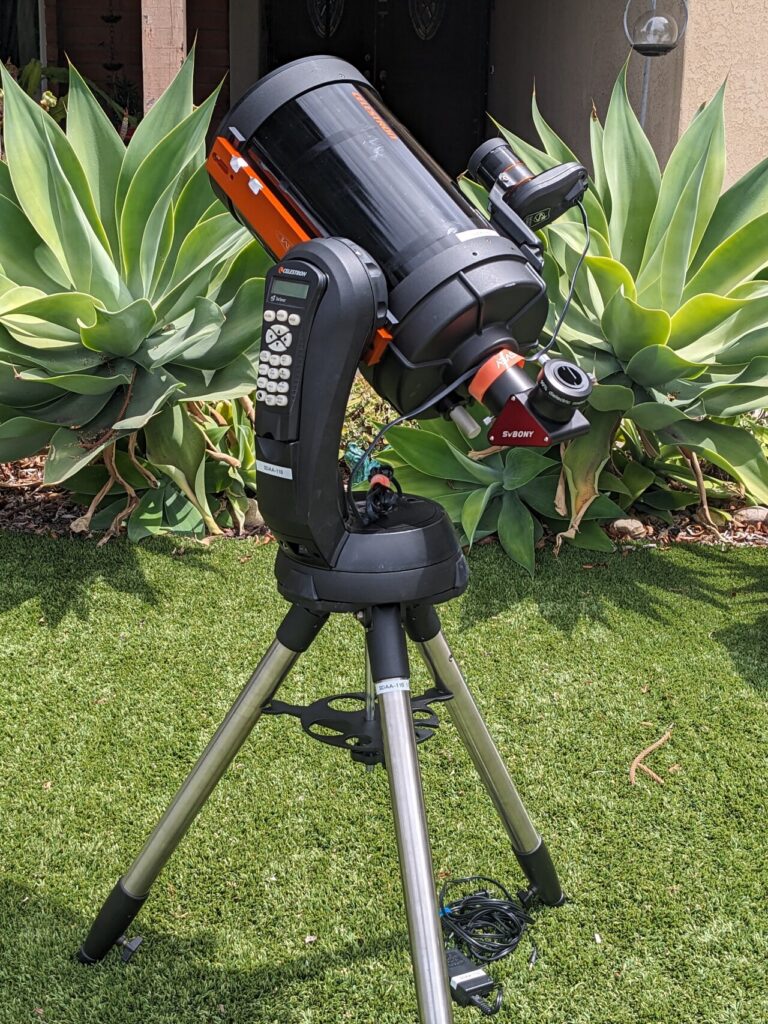
6″ Celestron 6SE
The Celestron NexStar 6SE is a popular entry-level Schmidt-Cassegrain telescope, ideal for both serious beginners and experienced users looking for an optical upgrade. It features a 6-inch aperture, a motorized GoTo mount for automatic object tracking, and is known for its impressive optics, particularly for viewing lunar and deep-sky objects. The mount can run from 8x AA batteries or the included AC adapter.
Includes the telescope and mount, an AC adapter, a red dot finder for performing initial alignment, and a 1.25″ visual back with Svbony mirror diagonal. This telescope does not include a camera.
SDAA-123
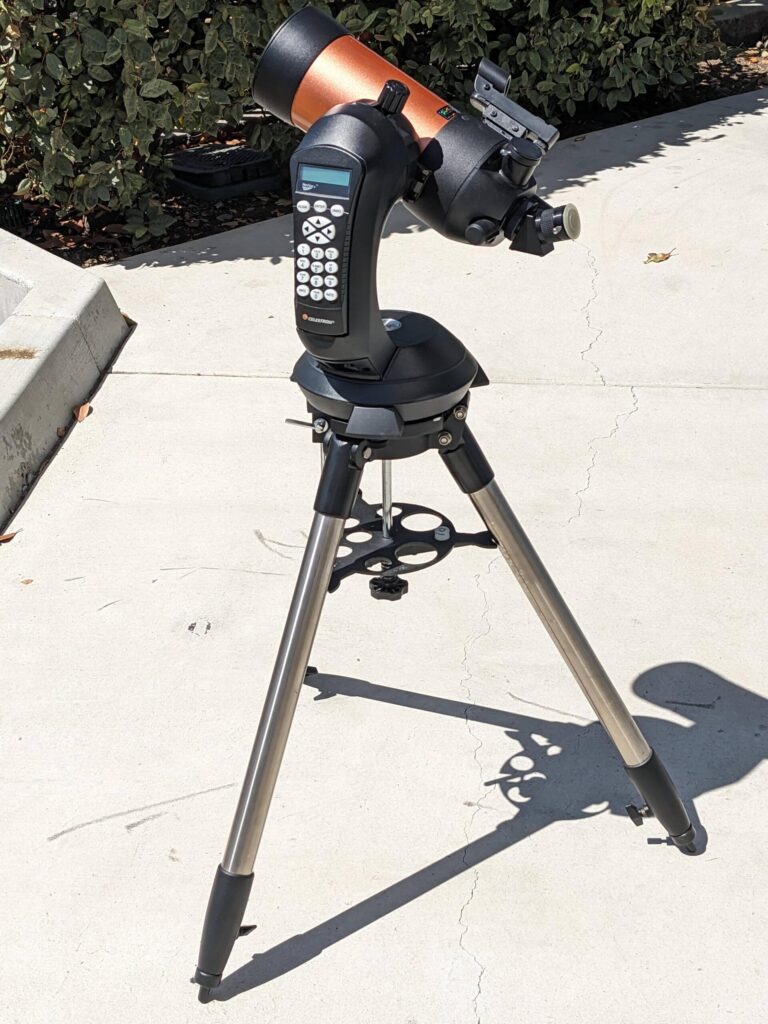
4″ Celestron 4SE
The smallest scope in Celestron’s popular NexStar SE lineup, the 4SE pairs a 102mm (4″) Maksutov-Cassegrain optical tube with a single-arm alt-az GoTo mount, all folding down into a compact, grab-and-go package. The long 1325mm focal length (f/13) makes this scope shine on the Moon and planets, delivering crisp, high-contrast views, though its narrow field of view and 1.25″-only eyepiece capacity make it less suited to wide-field deep-sky work. Like all the other Celestron SEs, this is a full GOTO telescope. At about 21 lbs fully assembled, with a steel tripod that includes a built-in wedge for equatorial tracking, it’s an easy scope to toss in a car for a quick night out, though members wanting wide starfields or serious deep-sky views should look to one of SDAA’s larger apertures instead.
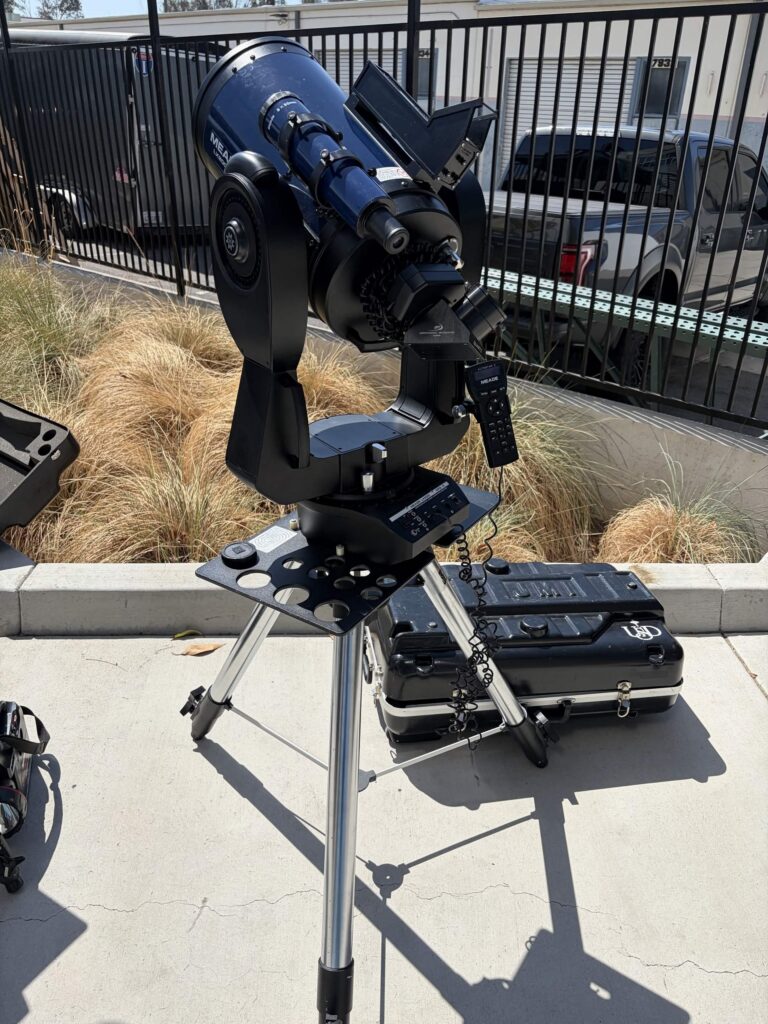
SDAA-121, SDAA-122
8″ Meade LX200
These well-equipped Meade SCTs ride on the LX200 mount, which is more sturdy and and stable than the LX90. These telescopes come with OPT’s legendary tripod plate, giving you a tidy working space to store your eyepieces while observing. Each scope comes in a hard-shell JMI wheely case, and comes with a 50mm straight-through finder, Telrad, and Autostar handset for full GOTO operation.
Both include 2″ visual backs and diagonals.
SDAA-004, SDAA-038
8″ Meade LX-90 SCT
A full computerized GOTO telescope, with Meade Autostar. This telescope, once properly aligned, will slew to virtually any object, then track it across the sky. 2000mm focal length f/10 optics with oversized primary mirror. Note that the tracking functionality is best for visual use; this scope is challenging to use for planetary astrophotography and does not include a camera.
Both of these telescopes include a 2″ visual back and diagonal.

SDAA-036
8″ Meade SCT on iOptron MiniTower Pro mount
This is a fantastic platform for learning planetary photography, or for a great night of visual observing. The iOptron MiniTower Pro mount is rock solid, all metal construction, and has absolute encoders on both axes to improve pointing accuracy. Built in GPS ensures high precision GoTo every time.
Includes everything you need: tripod, mount, 8″ f/10 OTA, 2″ visual back and diagonal, dew shield, and even includes a Celestron NexImage 10 solar system imaging camera. Also includes a cell phone camera holder and a second scope saddle, so you can mount your own telescope for dual-scope observing.
Note that the transit case on this kit is 80 pounds when loaded: you will need a helper to load it into and out of your vehicle.
SDAA-049
8″ Celestron NexStar CPC800 SCT
The Celestron NexStar CPC800 is a powerful 8-inch telescope designed for both beginners and experienced astronomers. Its NexStar control system features advanced GOTO capabilities, allowing you to easily locate and track thousands of celestial objects with just a few button presses. The dual-fork mount provides excellent stability, even in windy conditions, ensuring clear and steady views of the night sky. Whether you’re exploring planets, galaxies, or nebulae, the CPC800 offers a reliable and enjoyable observing experience.
Includes a dew shield, high quality 2″ William Optics diagonal, Telrad, and a comprehensive bound manual. Also includes a Nikon F-mount bayonet for attaching a Nikon DSLR. Note that as with all alt-az mounted telescopes, this telescope is not suitable for deep sky astrophotography. However, using the video mode of a DSLR, or a dedicated astro video camera, you can get excellent images of planets and the moon using “lucky imaging” techniques.


SDAA-078
8″ Celestron C8 SCT on iOptron MiniTower II mount
This compact observing system is an all-in-one solution for visual observing and planetary/lunar astrophotography. The MiniTower II mount is small but built tough with all metal internal gearing, and the iOptron Go2Nova hand control with built-in GPS makes setup and alignment easy.
Includes Celestron C8 8″ f/10 OTA with a William Optics 2″ dielectric mirror diagonal, dew shield, and Bahtinov mask. The telescope rides on an iOptron MiniTower II mount with iOptron PowerWeight battery that doubles as a counterweight.
Being an alt-az design, this telescope is not suitable for deep sky astrophotography. However, using the video mode of a DSLR, or a dedicated astro video camera, you can get excellent images of planets and the moon using “lucky imaging” techniques.
SDAA-091
10″ Meade SCT on Celestron CG-5 AS/GT mount
This large 10″ SCT collects 50% more light and has 25% better resolving power than an 8″ SCT. The scope rides on a sturdy Celestron CG-5 AS/GT equatorial mount with Nexstar+ GOTO handset. Includes a 2″ diagonal.
The 10″ scope is right at the capacity limit for the CG-5 mount. So you won’t be doing any astrophotography with this setup, but it works great for visual. If you have a planetary camera you will be able to use this setup to get great shots of the planets and the moon.


SDAA-093
8″ Celestron XLT SCT on Celestron CG-5 AS/GT mount
A versatile and capable observing platform, with a beefy Celestron CG-5 GOTO equatorial mount. The high quality 8″ SCT riding the mount has Celestron’s XLT coatings for a brighter image and better contrast. Includes everthing shown in the photo, including a 50mm Stellarvue right-angle finder scope and a 2″ visual back and diagonal.
This configuration is suitable for visual work and for planetary/lunar astrophotography. Deep sky astrophotography will be challenging due to the long focal length of the telescope, lack of a polar scope on the mount, and the absence of a guide scope.
Astrophotography Equipment (Deep Sky Photography)
Astrophotography is more accessible than ever, with the cost of telescopes, mounts, cameras, and accessories constantly dropping. Capturing images, stacking, and processing them is also getting much easier as software continues to improve. But make no mistake — getting amazing images like this still requires a huge amount of knowledge, patience, and the right equipment.
The SDAA can help you get started by getting you access to otherwise pricey equipment such as sturdy motorized german equatorial mounts, fast optical tubes, cameras, and guiding equipment. You can use this equipment to determine whether astrophotography is for you. If so, you will have real-world experience to inform your purchase decisions. If not, you won’t be stuck with equipment that you now have to sell.
There is also the SDAA Astro Imagers Special Interest Group (AISIG) that meets regularly to discuss all things astrophotography. After picking up your loaner astrophotography rig, it is recommended that you engage with AISIG to help you get your bearings and make the most of your loaned equipment.
SDAA-085: Beginner
ZWO SeeStar S50
The ZWO SeeStar S50 is an all-in-one smart telescope designed for easy astrophotography and observing. It features a 50 mm apochromatic triplet lens, built-in computerized mount, camera, and image-stacking software. Controlled entirely through a smartphone or tablet, the SeeStar automatically aligns itself, locates objects, and produces live-stacked images that improve in detail over time. Compact and lightweight, it’s ideal for quick setup and casual observing, while also giving beginners a simple entry point into deep-sky imaging. In addition to the automatic stacking and image adjustment capability, the SeeStar can also retain RAW image data which you can import into your favorite astrophoto editing program (such as PixInsight) to edit photos there.
Download the SeeStar app here:
Android: https://play.google.com/store/apps/details?id=com.zwo.seestar
iOS: https://apps.apple.com/us/app/seestar/id6447429891


SDAA-088: Beginner
Dwarf Labs Dwarf II
The Dwarf II is a compact, portable smart telescope ideal for beginner astrophotography and electronically assisted astronomy. It uses a dual-camera system and a dedicated app to automatically find, track, and stack images of celestial objects. The main telescope is 24mm aperture and 100mm focal length (f/4.2) with an 8MP sensor, while the wide field camera is a typical cell phone camera at 2.4mm focal length at f/2.4. The Dwarf app is easy to use, allowing you to capture images that are automatically stacked and stretched. The Dwarf II can retain RAW image data as well, allowing you to do your own calibration, stacking and image composition.
Download the DWARF app here: https://dwarflab.com/pages/dwarflab-app-firmware-download
SDAA-029: Beginner
iOptron Skyguider Pro with Accessories
Easy to use sky tracker that can accept your DSLR, mirrorless, point-and-shoot camera, or a small telescope. Includes everything you need (except the camera and lens) to start shooting deep sky exposures up to 10 minutes in length. Includes heavy duty 2″ steel tripod, upgraded William Optics alt-az base with polar scope, dual counterweights, heavy duty ball head mount for your camera, and a William Optics Vixen dovetail saddle for small telescopes. Also includes a Bahtinov mask to assist with focusing. The whole set packs up in two small boxes, plus the tripod: super easy to transport to dark skies.
This kit will introduce new astrophotographers to the concepts of polar alignment, tracking, and how to stack and process multiple exposures to create finished images.

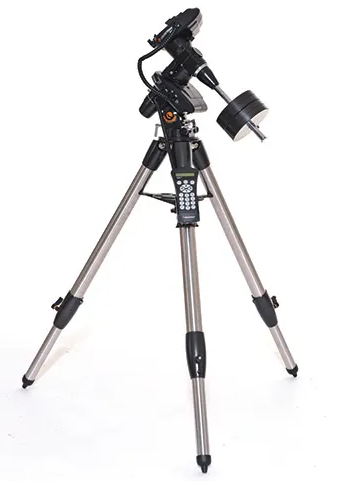
SDAA-027: Intermediate
Celestron CG-5 AS-GT German Equatorial Mount. Borrow this mount to get better acquainted with how to polar align and balance a GEM, align the pointing model, and control a telescope mount using your computer. With a good polar alignment, exposures of 2-3 minutes should be possible. The CG-5 mount is rated to carry a 30 lb. payload, but best photographic results will come from keeping the telescope+camera under 20 lb.
The CG-5 manual can be found here: https://s3.amazonaws.com/celestron-site-support-files/support_files/1145296473_advancedsgt.pdf and here’s a good blog post about how to set up and use a CG-5 mount: https://themcdonalds.net/setting-up-a-celestron-as-gt-go-to-mount/
Note that this kit does NOT include a telescope or a guide scope.
SDAA-077: Intermediate
iOptron GEM28 German Equatorial Mount. This is a high quality, precision mount with impeccable construction quality and an impressive feature set. The GEM28 is rated to carry a 28 pound instrument payload, though you should stick to 20 pounds or less for best results when imaging.
Comes with the GEM28 mount head, steel tripod with pier extension, Go2Nova handset, and a custom-cut foam carrying case that stores everything in a single easy-to-transport box. You can find the manual here: https://www.ioptron.com/v/Manuals/G28_GEM28_Manual.pdf
Note that this kit does NOT include a telescope or guide scope.


SDAA-032: Advanced
A complete deep sky astrophotography kit including the following:
– Meade LX85 German Equatorial Mount with polar scope and Audiostar GOTO
– Orion 8″ f/4 astrograph with 2″ focuser with 10:1 fine focus. Also includes a Bahtinov mask.
– 50mm guide scope with helical focuser
– Lodestar X2 guide camera (for guiding using your own laptop)
– Lacerta MGEN Autoguider system (for self-contained guiding)
– Canon EOS Rebel T3i DSLR with USB cable and digital intervalometer
This kit is for SDAA members who are already familiar with deep sky astrophotography technique, and how to properly use a German Equatorial Mount. You will advance your skills by learning to set up and balance a complex astrophotography rig, and to use a guide scope for autoguiding your long exposures. The included DSLR will introduce you to prime focus astrophotography, if you have been using a cell phone camera or point-and-shoot up to this point.
SDAA-053: Beginner
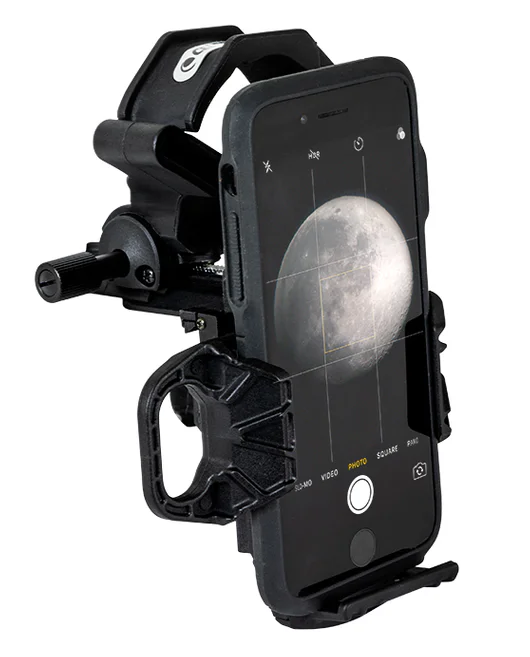
Celestron NexYZ 3-Axis Universal Smartphone Adapter
Use this adapter to attach your smartphone to the eyepiece of your telescope and take photos. Smartphone cameras can take amazing photos these days with surprisingly short exposures. The challenge is trying to position the tiny camera lens over the tiny exit pupil of your telescope. This adapter makes that process easy, by providing fine adjustments in three axes so that you can position your smartphone camera just right and hold it there while you set up your shot. See Celestron’s product page for more details.

SDAA-068: Beginner
Canon EOS / Nikon F T rings
These T adapters allow you to attach your Canon (EOS) or Nikon (F) DSLR to a telescope. The included 1.25″ T thread adapter will fit virtually any focuser. Note that you need a lot of back focus to use a DSLR with a T ring with a telescope. Most Newtonian scopes (unless specifically marketed as an “astrograph”) will not be able to reach focus. Refractors and SCTs should be fine.
SDAA-094: Intermediate
Meade Series 4000 0.63x reducer/flattener
Works with most SCTs to reduce the native f/10 focal ratio to a more photography-friendly f/6.3, as well as reducing the focal length by 0.63x. Note that for proper field flattening and focal reduction, your camera sensor should be placed about 100mm from the rear of the reducer. You may need spacer rings to ensure proper distance.
Compatible with common Meade and Celestron SCTs. NOT compatible with Celestron’s EdgeHD SCTs. On Celestron C14s (native f/11) the resulting focal ratio will be f/7, not f/6.3.

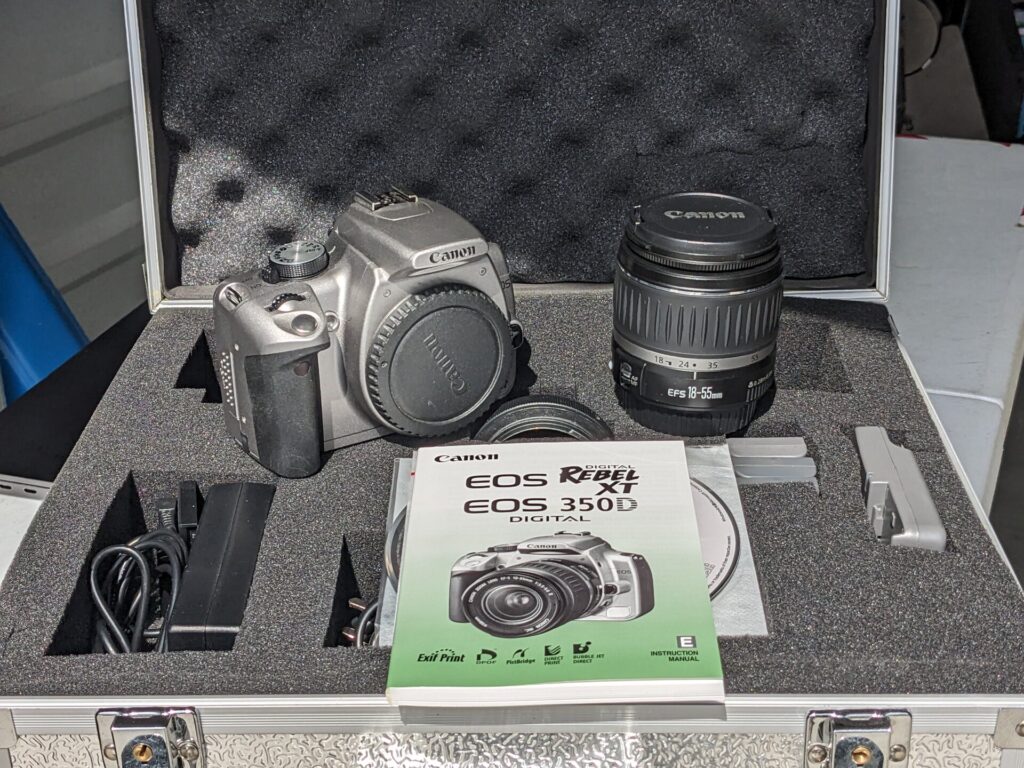
SDAA-107: Canon EOS 350D (astro-modified): Intermediate
This kit includes everything you need to take high resolution deep sky images through your telescope, or using the included kit lens. The sensor on this camera has been modified to remove the IR-cut filter, so it has enhanced sensitivity in the red part of the spectrum, allowing for better capture of H-alpha features in emission nebulae.
Includes the camera body, three batteries, battery charger, AC adapter, manual, software, cables, and a 1.25″ nosepiece, to fit any telescope.
Use this kit with your own telescope, or with the SDAA-029 iOptron Skyguider Pro star tracker, to gain experience with taking long exposure photos of deep sky objects.
SDAA-099: Advanced
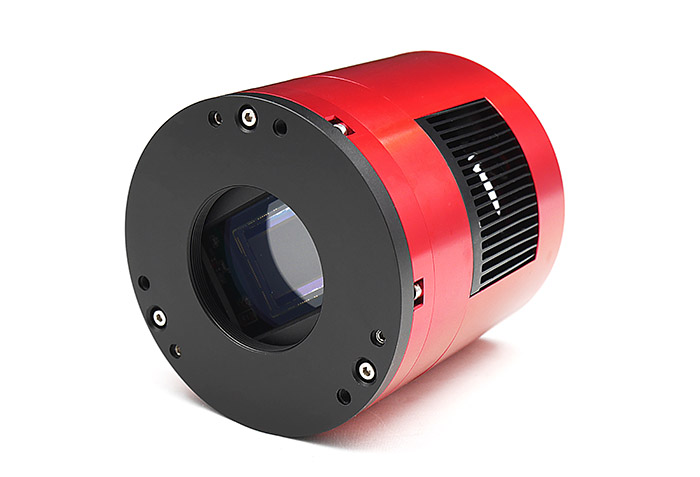
ZWO ASI071MC Pro cooled one-shot-color CMOS camera
Based on the same large CMOS sensor used in many commercial DSLR systems, the ZWO ASI071MC-Pro is a color astronomy camera designed for deep-sky, lunar/solar, and planetary imaging. At the heart of the camera lies the Sony Exmor IMX071 ASP-C sensor with 16.2 megapixels, a resolution of 4944X3284, large 4.8μm pixels, and low 2.3e read noise. With regulated two-stage TEC cooling, this camera can cool the sensor to 35C to 40C below ambient to keep noise in your images to a minimum.
The fast USB3.0 interface on the ASI071MC-Pro allow transfer rates of up to 10 frames per second at full 4944X3284 resolution. At reduced resolution of 640×480, download rates up to 70 fps become possible. The camera enables exposure times of 64μs to 2000s (33.3 minutes).
Includes the camera, 1.25″ and 2″ nosepieces, a 12V power supply, 6 foot USB cable, and a carrying case.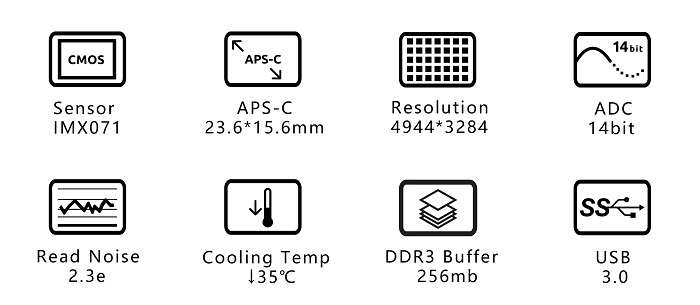
SDAA-040, SDAA-098: Advanced
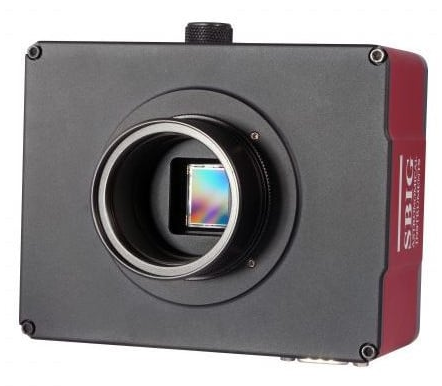
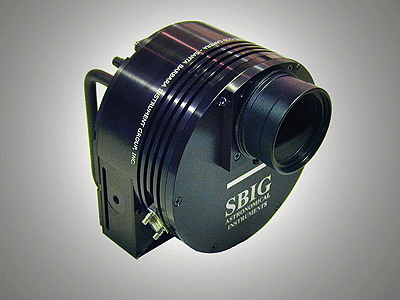
Santa Barbara Imaging Group (SBIG) STF-8300C cooled one-shot-color CCD camera
The STF-8300C (color) camera is based on Kodak’s KAF-8300, 8.3 megapixel (3326×2504), full frame CCD. The KAF-8300 CCD is approximately 18 x 14mm (1.5″, smaller than APS-C but bigger than micro 4/3) and has a diagonal measurement of about 22 millimeters. With its relatively small pixels (5.4µm x 5.4µm) and large image area it is ideal for wide field imaging with short fast telescopes and camera lenses and at the same time is flexible enough to be used on long focal length Schmidt-Cassegrains.
This is an older camera, but is fully ASCOM compliant and can still be controlled with modern astrophotography software through ASCOM. A guide for mounting the camera, setting up drivers, and configuring the camera with NINA is provided by the SDAA loaner program.
SDAA-040 comes with a 2″ nosepiece, 2.5x 2″ barlow, 12v power supply, USB cable, and a hard-shell carrying case. SDAA-098 comes with 2″ and 1.25″ nosepieces, a pair of T2 extension rings, a 12v power supply, USB cable, and a hard-shell carrying case.
SDAA-050+SDAA-052: Advanced
Santa Barbara Imaging Group (SBIG) ST-10XME cooled, self-guiding mono CCD camera with ten-position filter wheel (SDAA-050) plus optional SBIG CCDH-1 remote guide head (SDAA-052).
The Model ST-10XME is the flagship of the “ST” series of self-guiding CCD cameras from SBIG. Like other self-guiding cameras in the ST series, the ST-10XME contains two CCDs. The imaging CCD is an enhanced KAF-3200ME imaging detector from Kodak with 3.2 million pixels, 2184×1472 resolution on a sensor measuring 14.9×10 mm. This is close to the 1″ sensor format. The camera includes a built-in TC-237H tracking CCD, eliminating the need for an off-axis guider pick-off mirror, or a secondary guide scope+camera.
The Kodak KAF-3200ME CCD has amazing quantum efficiency of as high as 90% across the 550-700nm portion of the visible spectrum. It has ultra-low dark current of less than 1e-/pixel/second at 0 degrees C (typical) that allows moderate cooling for applications involving extended exposures. The high sensitivity of this sensor makes this camera ideally suited for shooting through narrowband filters.
This is an older camera, but is fully ASCOM compliant and can still be controlled with modern astrophotography software through ASCOM. A guide for mounting the camera, setting up drivers, and configuring the camera with NINA is provided by the SDAA loaner program.
Comes with 1.25″, 2″, and SCT thread nosepieces, power supply, 20 foot USB cable, desiccant packets, and a 10-position filter wheel containing Astrodon L, R, G, B, Ha, and OIII narrowband filters. Also includes a special Green Continuum filter with a 10nm bandpass around 510nm, used for scientific applications such as photometry.

SDAA-064: Intermediate
Astronomik EOS APS-C Clip-in Filters
Three Astronomik filters mounted in a clip-in adapter for Canon EOS APS-C DSLR camera bodies. The filter clips in just in front of the mirror, behind the lens bayonet. See the Astronomik product page for details. Includes three filters: SII-CCD (sulphur II), CLS (broadband light pollution), and UHC (combined OIII and H-beta).
SDAA-069: Intermediate
Astronomik T2 thread CLS filter
This is Astronomik’s CLS broadband light pollution filter, which cuts the light emitted by mercury vapor and both high and low pressure sodium lamps. This filter has T2 threads, and thus is meant to thread onto your camera’s T adapter inline with your imaging train. It will NOT thread onto a 2″ eyepiece.

Eyepiece Kits
Premium eyepiece kits are available for members to loan, for use either with their own telescopes or with loaner telescopes. Try out different focal lengths and optical designs before you buy them for yourself!
SDAA-111
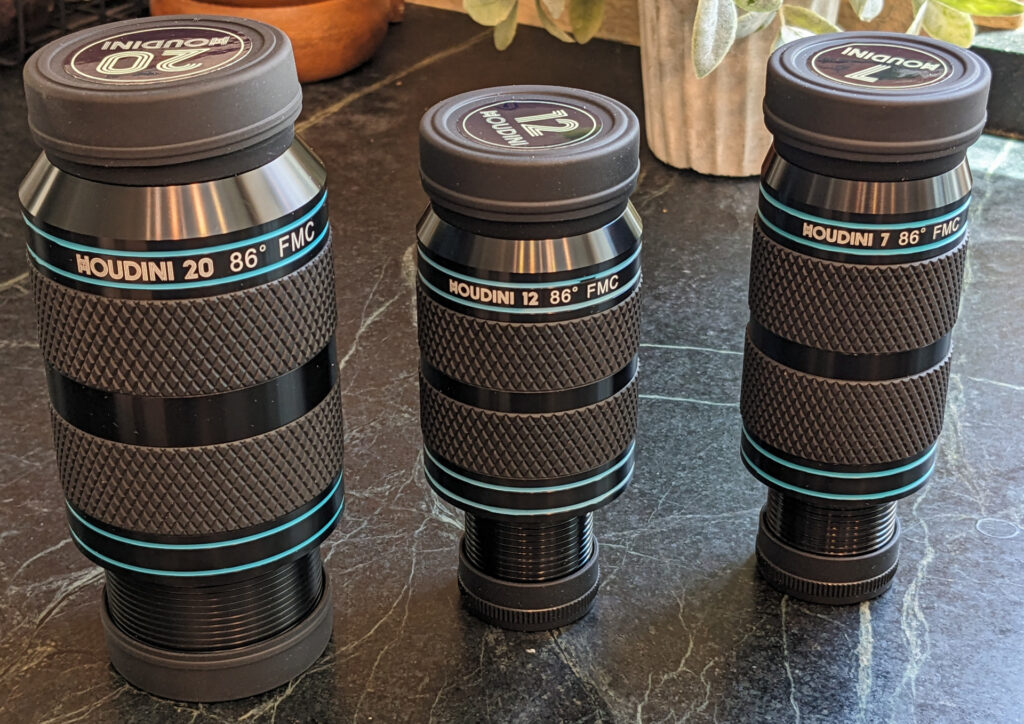
Houdini 86° Coma-Correcting Eyepieces (best with <= f/5 scopes)
The Houdini series is a newer line of eyepieces with a distinctive feature: built-in correction for parabolic coma, eliminating the need for a separate coma corrector in Newtonian telescopes. Coma is an optical aberration inherent to fast parabolic mirrors that causes stars near the edge of the field to appear smeared or seagull-shaped — a common frustration for owners of fast Newtonians (f/5 and below).
The Houdinis deliver an ultra-wide 86° apparent field of view with sharp, high-contrast views and minimal aberrations, and require no spacing adjustments or separate corrector accessories. All eyepieces feature full multicoating, blackened lens edges, high-index glass, a fold-down eye guard, comfortable rubber grips, and filter threads.
Kit includes:
– 20mm Houdini 86° Coma-Correcting Eyepiece (2″)
– 12mm Houdini 86° Coma-Correcting Eyepiece (1.25″)
– 7mm Houdini 86° Coma-Correcting Eyepiece (1.25″)
– Weatherproof case
SDAA-112
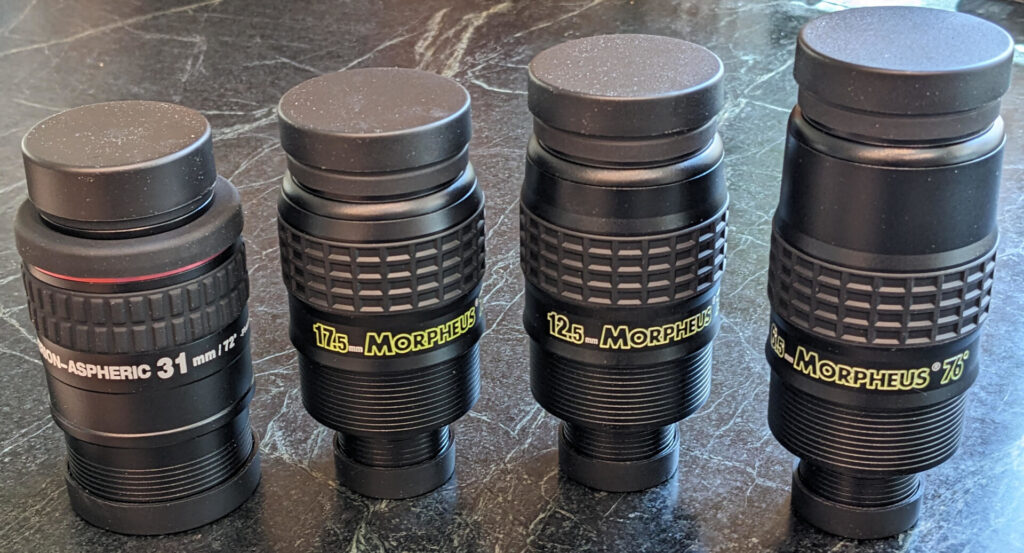
Baader Morpheus 76° long eye relief (best with <= f/6 scopes)
The Baader Morpheus series represents a strong balance of optical quality, wide apparent field of view (76°), and ergonomic design. Built in Germany to tight tolerances, Morpheus eyepieces deliver sharp, high-contrast views with excellent eye relief (20.5 mm across all focal lengths), making them comfortable for extended observing sessions — including for eyeglass wearers.
A twist-up eyecup and non-rotating barrel make them easy to handle in the dark. Chromatic correction is excellent, and the wide field makes them particularly enjoyable for both planetary work and sweeping star fields.
Kit includes:
– 31mm Baader Hyperion Aspheric 72° 2″
– 17.5mm Baader Morpheus 76° 2″/1.25″
– 12.5mm Baader Morpheus 76° 2″/1.25″
– 6.5mm Baader Morpheus 76° 2″/1.25″
– Weatherproof case
SDAA-044
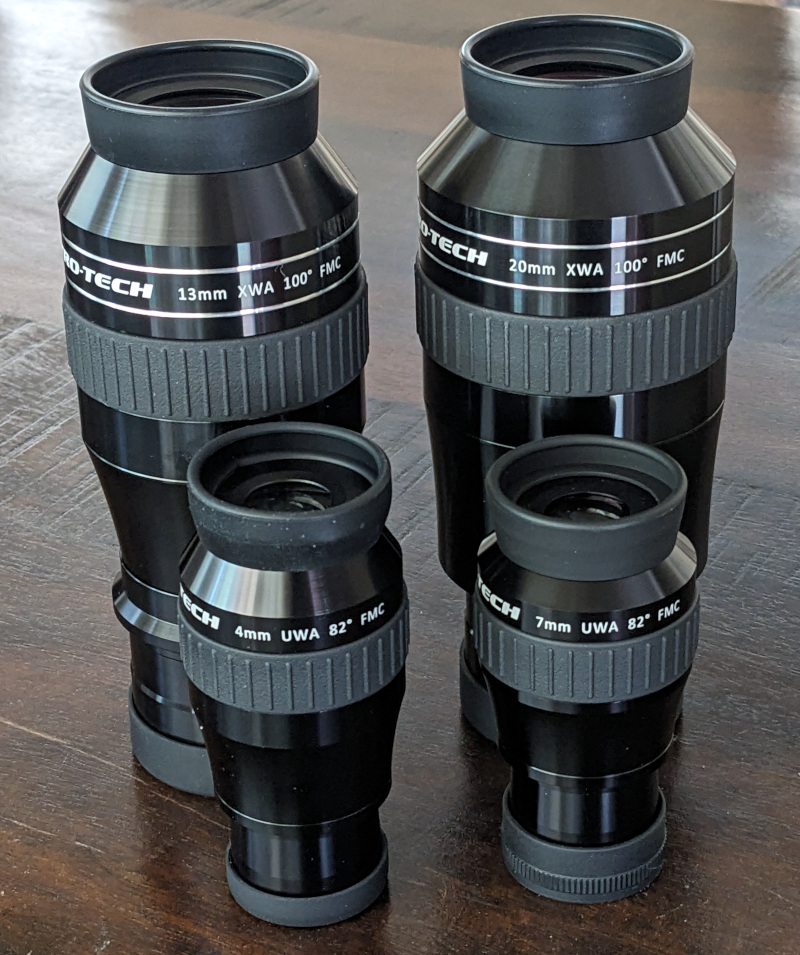
Astro-Tech Hyperwide (100°) and Ultrawide (82°) kit (best with <= f/5 scopes)
Astro-Tech XWA and UWA eyepieces have high contrast, comfortable eye relief, and full field sharpness – with well-controlled astigmatism, field curvature, and lateral color. All eyepieces include soft rolldown eyecups to shield your eye from ambient light and improve the image contrast. The XWA (100°) eyepieces are favorably compared with Televue Ethos, and the UWA (82°) are favorably compared with Televue Nagler.
If you have been wanting to try out the immersive, “spacewalk” effect of hyperwide eyepieces on your f/4-f/5 scope, this set will certainly impress.
Kit includes:
– 20mm XWA (100°) 2″
– 13mm XWA (100°) 2″ or 1.25″
– 7mm UWA (82°) 1.25″
– 4mm UWA (82°) 1.25″
– Weatherproof case
SDAA-086
Astro-Tech Ultrawide (82°) kit with Televue Ethos (best with <= f/10 scopes)
This kit features a complementary set of ultrawide 82° eyepieces to SDAA-044, while also including a donated Televue Ethos 17mm to cover the critical 2-4mm exit pupil “faint fuzzy” observing range. The 28mm UWA gives nearly the maximum TFOV for a 2″ focuser, while the 17mm Ethos is ideal for hunting faint fuzzies in f/6-f/10 scopes. The included barlow allows for doubling the magnification of the 10mm and/or 7mm eyepieces, making this kit suitable for both fast and slow scopes, with a range of premium eyepieces to observe any object you come across.
Kit includes:
– 28mm UWA (82°) 2″
– 17mm Televue Ethos XWA (100°) 2″
– 10mm UWA (82°) 1.25″
– 7mm UWA (82°) 1.25″
– Celestron Ultima SV 2x barlow
– Weatherproof case

SDAA-045
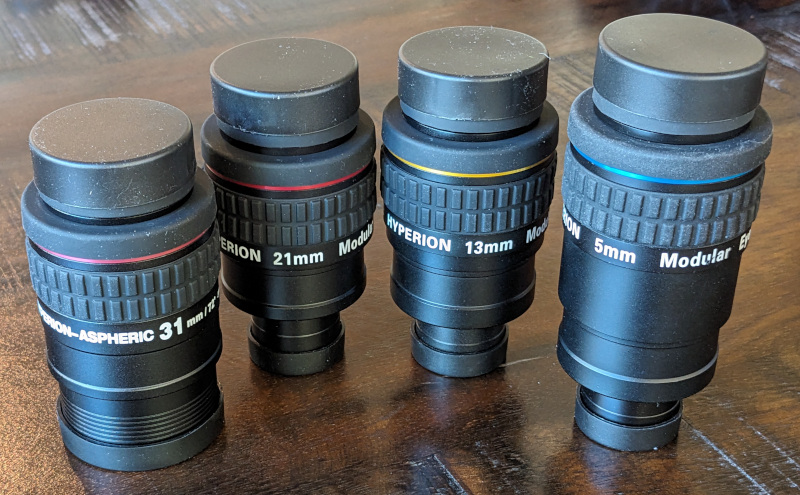
Baader Hyperion Superwide (72° and 68°) kit (best with >= f/5 scopes)
The Baader Hyperion series of eyepieces are renowned among amateur astronomers for their exceptional versatility and performance. These eyepieces are designed with a wide 68-degree apparent field of view, providing an immersive experience that makes celestial observations feel expansive and detailed. Their high-quality optical construction, including multi-coated lenses, delivers sharp, high-contrast images with minimal chromatic aberration and minimal color cast, making them ideal for both planetary and deep-sky viewing. Furthermore, their comfortable eye relief and compatibility with both 1.25-inch and 2-inch focusers make them a popular choice for those looking to enhance their stargazing sessions with superior clarity and ease of use.
Kit includes:
– 31mm Hyperion Aspheric (72°) 2″
– 21mm Hyperion (68°) 1.25″
– 13mm Hyperion (68°) 1.25″
– 5mm Hyperion (68°) 1.25″
– Weatherproof case
SDAA-046
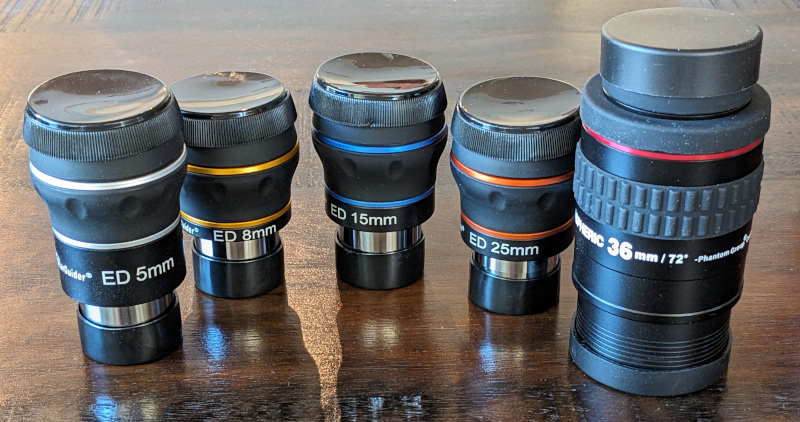
Agena Starguider Dual ED (60°) kit (best with >= f/6 scopes)
With a true flat field and two high quality ED glass elements of different glass types, the Agena StarGuider Dual ED eyepieces (also known as the Astro-Tech Paradigm) are characterized by a significantly high contrast image. These 1.25″ fully multicoated (FMC) eyepieces give maximum detail and definition across the entire 60° field of view (FOV).
Kit includes:
– 36mm Baader Hyperion Aspheric (72°) 2″
– 25mm Agena Starguider Dual ED (60°) 1.25″
– 15mm Agena Starguider Dual ED (60°) 1.25″
– 8mm Agena Starguider Dual ED (60°) 1.25″
– 5mm Agena Starguider Dual ED (60°) 1.25″
– Weatherproof case
SDAA-047
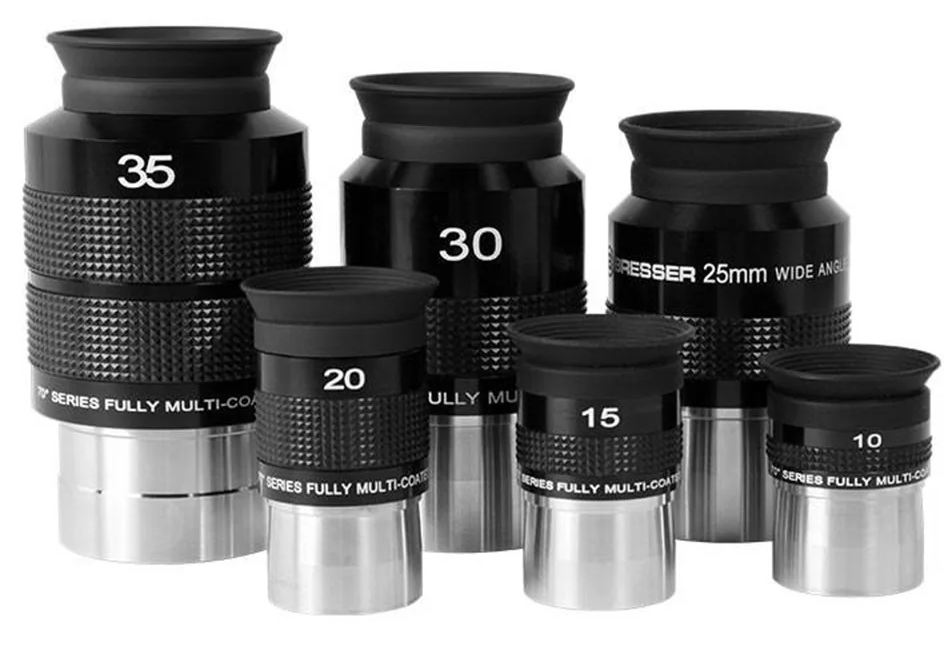
Explore Scientific / Bresser 70° Series kit (best with >= f/6 scopes)
This eyepiece design, available generically as the GSO SuperView, represents a major advance compared to the original Plössl and Super-Plössl design. The five element design features tack sharp optical performance which delivers a improvement in corrections for chromatic aberration and edge-sharpness compared to traditional Plössl. The observing comfort is also much better with this eyepieces than with the conventional Plössl design. A good choice for telescopes with relaxed focal ratios.
Kit includes:
– 34mm SVBONY SV136 72° 2″
– 30mm Bresser 70° 2″
– 25mm Bresser 70° 2″
– 20mm Bresser 70° 1.25″
– 15mm Bresser 70° 1.25″
– 10mm Bresser 70° 1.25″
– Padded carrying case with bolt cases for each ocular
SDAA-116
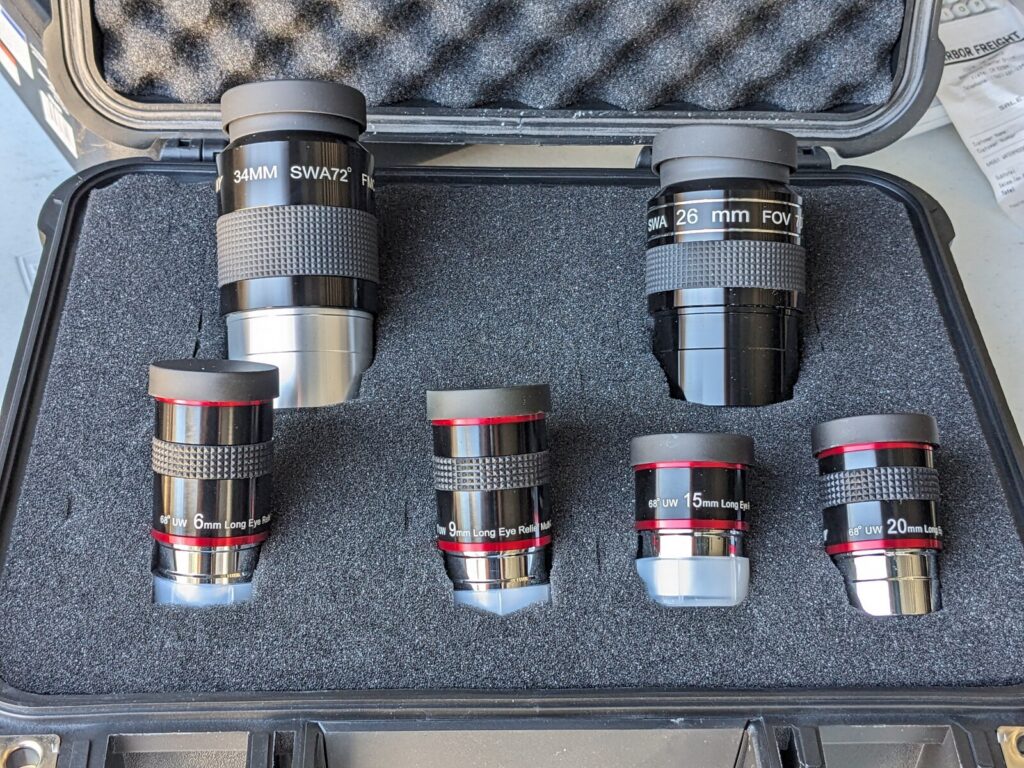
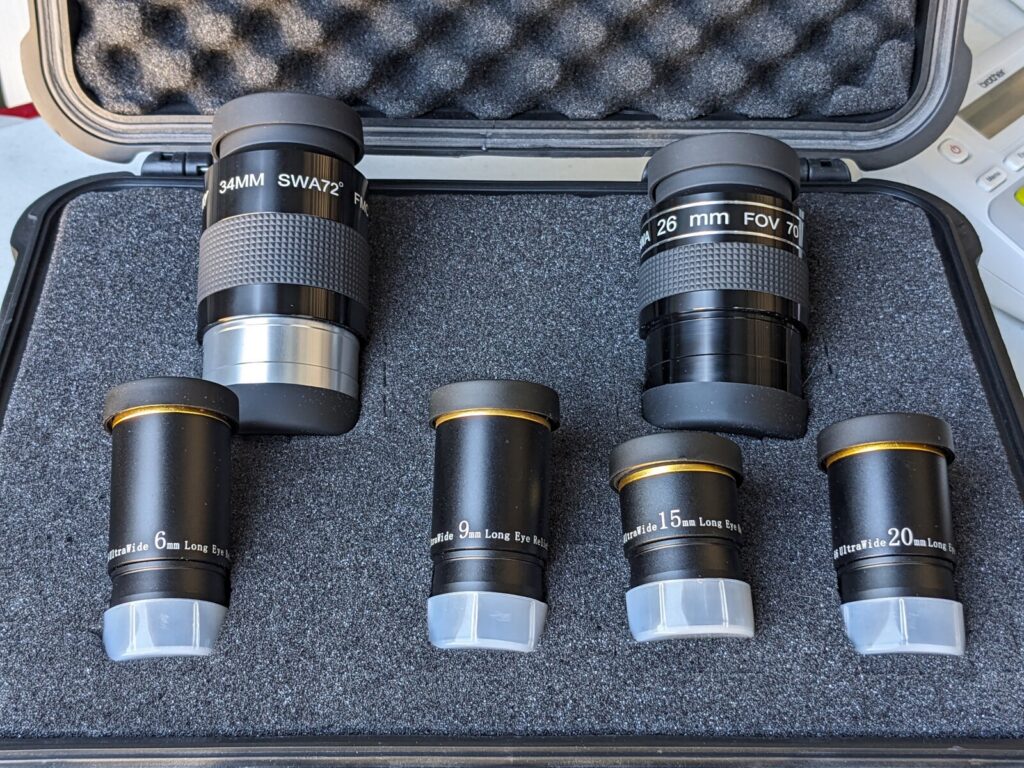
SVBONY Redlines
On many astronomy forums, SVBONY Redlines (and Goldlines, see below) are recommended as an affordable first step into premium eyepieces, replacing or agumenting the generic Plossls that came with your telescope. Check out this kit to see if they’re worth it!
The SVBONY Redlines feature a generous 68° AFOV for an immersive view, and generally have better eye relief than the Goldlines. Fully multicoated optics.
Kit includes:
– 34mm SVBONY 72° (2″)
– 26mm SVBONY 70° (2″)
– 20mm, 15mm, 9mm, 6mm SVBONY Redline 68°
– Hardshell case
SDAA-117
SVBONY Goldlines
On many astronomy forums, SVBONY Goldlines (and Redlines, see above) are recommended as an affordable first step into premium eyepieces, replacing or agumenting the generic Plossls that came with your telescope. Check out this kit to see if they’re worth it!
The SVBONY Goldlines have a 68° AFOV and are based on the legendary König optical design. Fully multicoated optics.
Kit includes:
– 34mm SVBONY 72° (2″)
– 26mm SVBONY 70° (2″)
– 20mm, 15mm, 9mm, 6mm SVBONY Goldline 68°
– Hardshell case
SDAA-087, SDAA-115
SVBONY premium zoom eyepieces
This pair of premium zoom eyepieces compare favorably with similar designs from Zeiss, Leica, and Pentax. Use the 3-8mm for high magnification observation of planetary nebulae, double stars, and planets, and the 8-20mm for galaxies, nebulae, and star clusters. Don’t let the SVBONY name fool you, these are premium oculars with aspheric fully multicoated lenses that offer well controlled field curvature, parfocal behavior, click-stop focal lengths, generous AFOV, and comfortable eye relief. The SV230 has a screw-on 2″ adapter that is flush with the standard 1.25″ nosepiece, making it work comfortably in any telescope, as well as allowing it to work with both 1.25″ and 2″ threaded filters.
Kit includes:
– SVBONY SV230 8-20mm zoom with 57° (20mm) – 72° (8mm) AFOV 1.25″ or 2″
– SVBONY SV215 3-8mm zoom with constant 56° AFOV 1.25″
– Weatherproof case

SDAA-103
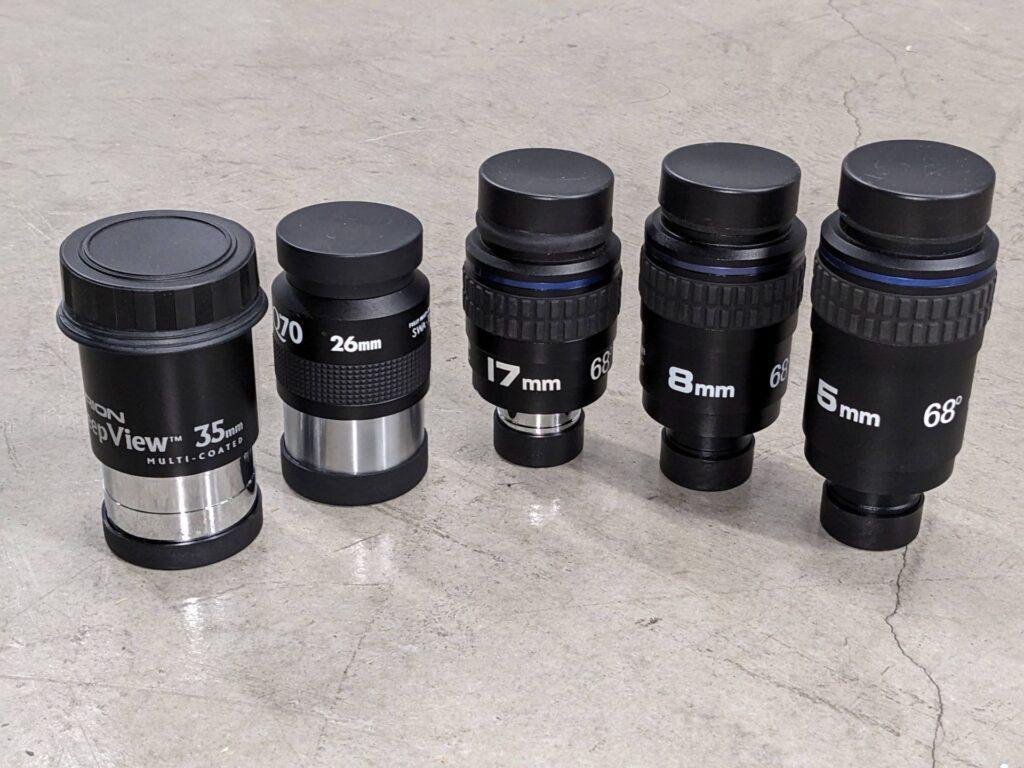
Premium Orion Eyepiece kit (best with <= f/6 scopes)
Includes:
– 35mm Orion DeepView (2″)
– 26mm Orion Q70 70° (2″)
– 17mm Orion Stratus 68°
– 8mm Orion Stratus 68°
– 5mm Orion Stratus 68°
– case
SDAA-054
Premium Mixed Eyepiece kit (best with <= f/5 scopes)
Includes:
– 28mm Orion DeepView (2″)
– 21mm Baader Hyperion 68° (1.25″/2″)
– 10mm Baader Hyperion 68° (1.25″/2″)
– 7.5mm Orion Ultrascopic
– 2x apochromatic triplet barlow
– case


SDAA-055
Premium Mixed Eyepiece kit (best with f/6 scopes)
Includes:
– 31mm Baader Hyperion Aspheric 72° (2″)
– 20mm Meade SWA 82°
– 12.4 Meade Series 4000 Super Plossl
– 6mm Orion Expanse
– case
SDAA-056
Premium Mixed Eyepiece kit (ideal for SCTs)
Includes:
– 40mm Explore Scientific 68° Series for maximum field of view
– 23mm Celestron Luminos (2″)
– 14.5mm Orion Edge-on Planetary
– 8mm Celestron XCel
– case


SDAA-057
Premium Plossl Eyepiece kit (ideal for SCTs)
Includes:
– 40mm Meade Series 4000 Plossl (2″) for maximum field of view
– 32mm Televue Plossl
– 27mm Televue Panoptic
– 20mm Televue Plossl
– 15mm Televue Plossl
– 9mm Explore Scientific 62° Series
– case
SDAA-092
Mixed Premium Eyepiece kit (ideal for SCTs)
Includes:
– 56mm Meade Super Plossl (2″) for maximum field of view
– 28mm Meade SWA (82° AFOV, 2″)
– 14mm Meade UWA (85° AFOV, 1.25″ or 2″)
– 9.7mm Meade Super Plossl
– case


SDAA-058
Mixed Premium Eyepiece kit (best with >= f/6 scopes)
Includes:
– 35mm Parks Gold Series
– 28mm Orion DeepView (2″)
– 21mm Celestron XCel
– 17mm Vixen LVW
– 8mm Vixen LVW
– 5mm Starguider clone
– case
SDAA-059
Premium Eyepiece kit (best with >= f/5 scopes)
Includes:
– 40mm Plossl
– 35mm Celestron Ultima
– 26mm Zhumell WA (2″)
– 18.2mm Televue DeLite
– 8mm Televue DeLite
– 2x Barlow
– case

SDAA-113, SDAA-114
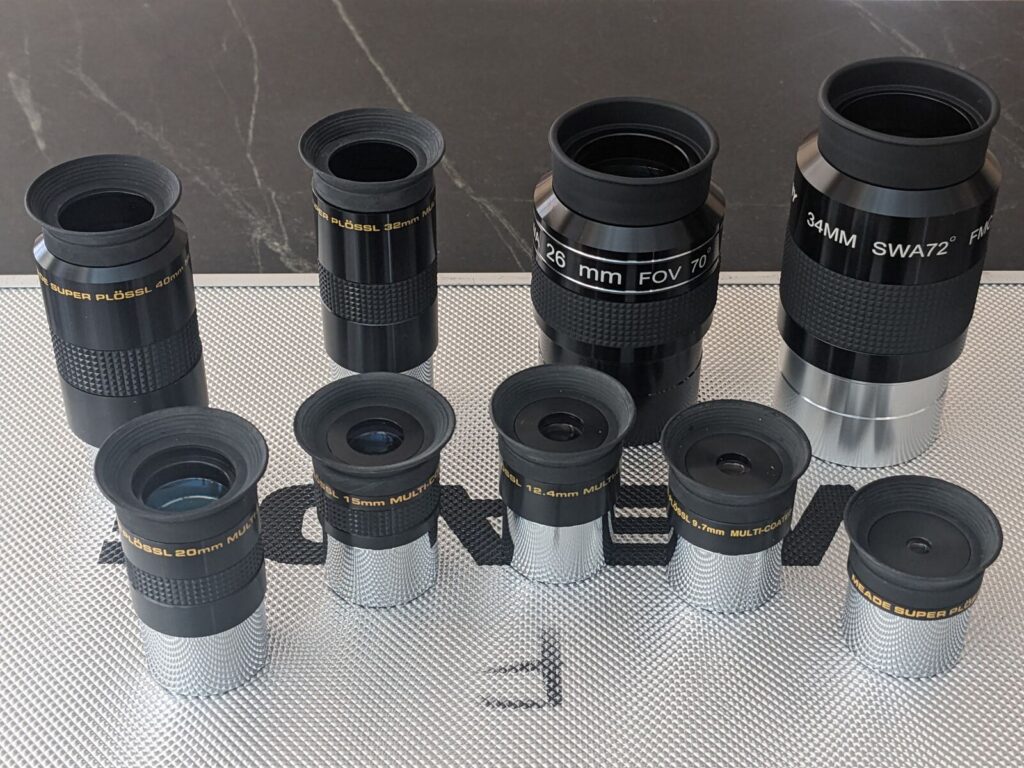
Enhanced Plossl Eyepiece kit (best with >= f/6 scopes)
A complete set of Meade Series 4000 Plossl eyepieces, enhanced with a pair of SVBONY 2″ wide angle eyepieces. Get the maximum field of view from a 2″ focuser with the big 2″ eyepieces, and sharp, contrasty on-axis views from the Plossls.
Kits include:
– 34mm SVBONY 72° (2″)
– 26mm SVBONY 70° (2″)
– 40mm, 32mm, 20mm, 15mm, 12.4mm, 9.7mm, 6.4mm Meade Series 4000 Plossls
– Hardshell case
SDAA-048, SDAA-075, SDAA-071, SDAA-073, SDAA-080, SDAA-102
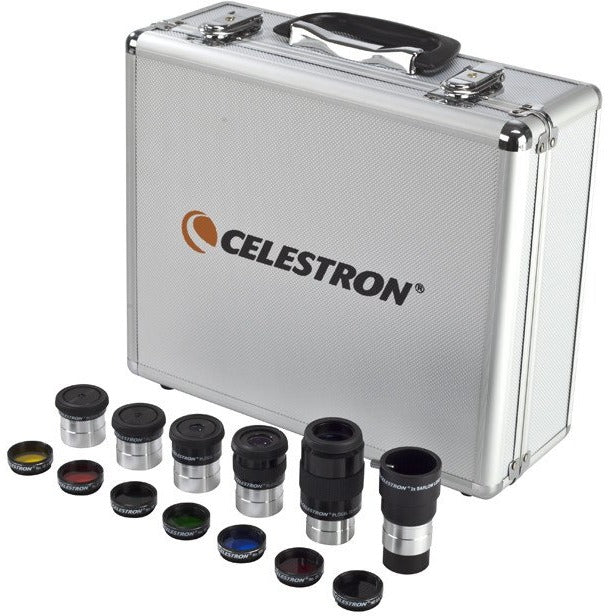
Generic Orion/Celestron Plossl Eyepiece kit (best with >= f/6 scopes)
Celestron / Orion’s entry-level Plossl eyepiece set. Plossl eyepieces have a 50° apparent field of view and comfortable eye relief in longer focal lengths. These are the types of eyepieces typically included with a new telescope.
Kits include:
– 32mm Plossl
– 17mm Plossl
– 13mm Plossl
– 8mm Plossl
– 6mm Plossl
– 2x Barlow
– Color filters
– Hardshell case
Miscellaneous Equipment
Some unusual or specialized equipment is also available to loan. For example, solar telescopes that are used during the day!
SDAA-097
Coronado SolarMax II 60 Hα Telescope
Coronado by Meade SolarMax II 60mm Solar Telescope with RichView system. Includes 10mm Blocking Filter. 60mm diameter Solar Telescope with sub 0.7 angstrom bandwidth filtering for observation of surface detail and prominences on the Sun in hydrogen-alpha (Ha) light.
Used around the world by serious solar enthusiasts and professional research facilities alike for observation of surface detail and prominences on the Sun in hydrogen-alpha (Ha) light. Powerful but very portable, this high resolution Solar Telescope offers dedicated visual observation of the Sun as well as high quality imaging.
Includes 25mm Cemax and 9.7mm Meade Plossl eyepieces and a hard shell carrying case. Telescope is 60mm aperture f/6.6 (400mm focal length). Requires a mount with a Vixen-style dovetail saddle. At six pounds it can be carried by the iOptron Cube Pro mount (SDAA-074) for visual use.


SDAA-034, SDAA-037
Coronado Personal Solar Telescope (PST)
Coronado’s iconic Personal Solar Telescope (or PST for short) is an incredibly portable way to view the sun in hydrogen-alpha light, capable of sitting on top of even modest photo tripods. The Sun’s got a lot going on, and the PST will show it to you. By zeroing in on the far end of the Sun’s visible light spectrum — the hydrogen-alpha line — the PST reveals our closest star rolling with violent, ever-changing activity. 40mm f/10 optics with a <1.0 Å bandpass etalon. Observe solar prominences and surface granulation impossible to see with a simple white-light solar filter.
Note that these telescopes are not suitable for taking photos of the sun. They are visual instruments only.
We have two of these telescopes available to loan. Both have Vixen-style dovetails, or may be mounted to a sturdy photo tripod. You might also consider borrowing SDAA-074 (below) to mount it. We also have an Orion AstroView mount (manual GEM) available if you wish to use a beefier mount.
SDAA-090
William Optics Binoviewer
Experience the joy of observing with both eyes open with the venerable William Optics binoviewer. This kit comes with everything you need to get started:
– Premium William Optics binoviewer
– Thread-on 1.6x barlow nosepiece
– Matched pairs of Meade Series 4000 Super Plossls
40mm, 26mm, 20mm, 15mm
– Hardshell case

SDAA-074
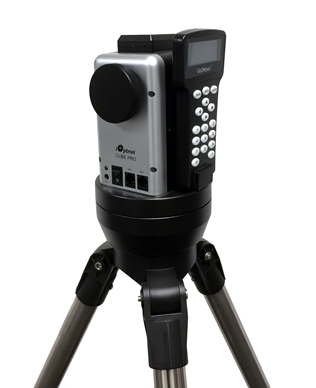
iOptron Cube Pro mount
This tiny little 3 pound alt-az mount can carry an 8 pound payload on its side saddle. Perfect for lightweight telescopes like small 80mm refractors, or reflectors up to 114mm. The mount runs on 8x AA batteries and has full tracking and GOTO capability.
Includes the mount, hand control, tripod, and a padded carrying case.
SDAA-039
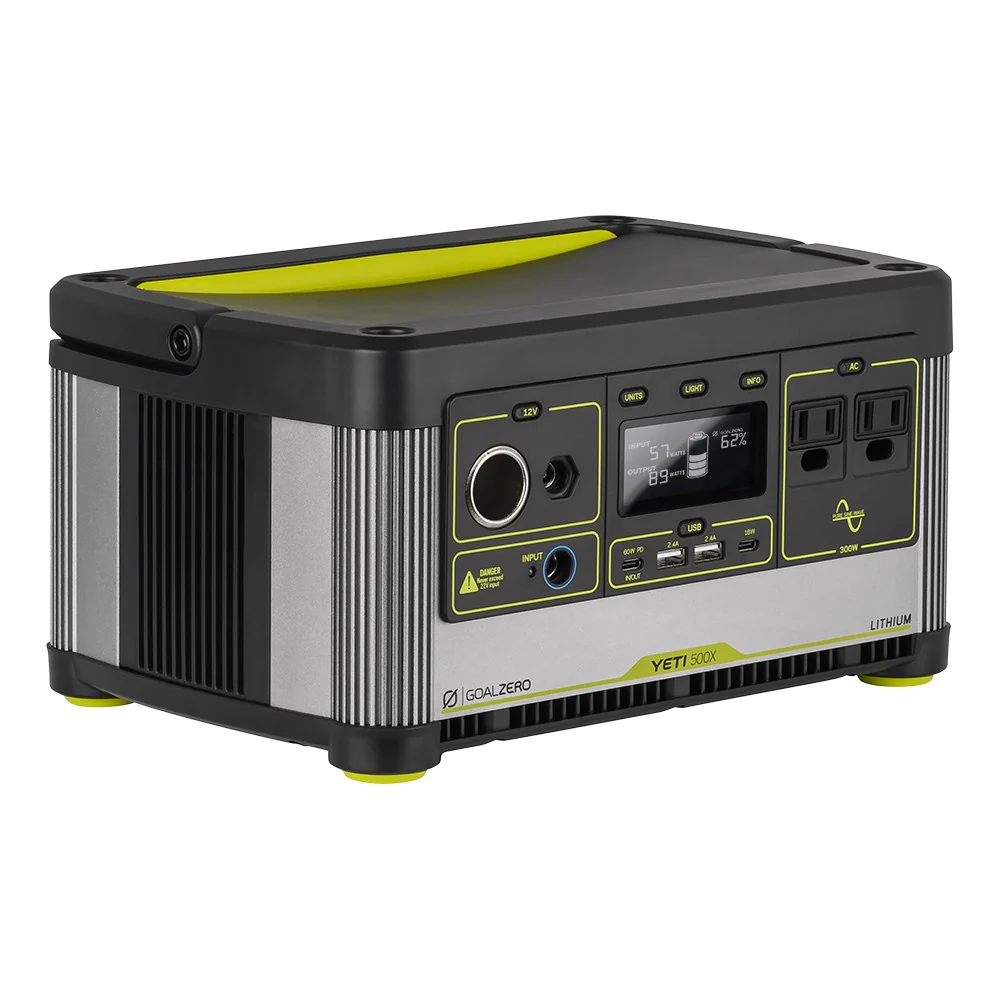
GoalZero Yeti 500x Power Station
Portable power station with 12V, 60W USB-PD, and 300W 110V AC inverter. 500Wh Lithium battery. Includes soft carrying case.

SDAA-081, SDAA-095
Celestron Power Tank
Portable 12V 7Ah power box with two 12V cigarette lighter power outlets as well as a bright floodlight and red spotlight. Includes a cigarette lighter to barrel jack cable for powering most telescope mounts, and a 15V AC adapter for charging the battery.
SDAA-043
Baader Solar Filter for 8″ Dobsonian Telescopes
This solar filter accessory clips onto the front of solid-tube 8″ Dobsonians like SDAA-026, SDAA-031 and SDAA-042. When in place, it allows you to observe the sun in full spectrum white light. Excellent for observing sunspots. If you want to see prominences and surface granulation, you need a Hydrogen Alpha telescope, such as SDAA-034 or SDAA-037.

SDAA-104
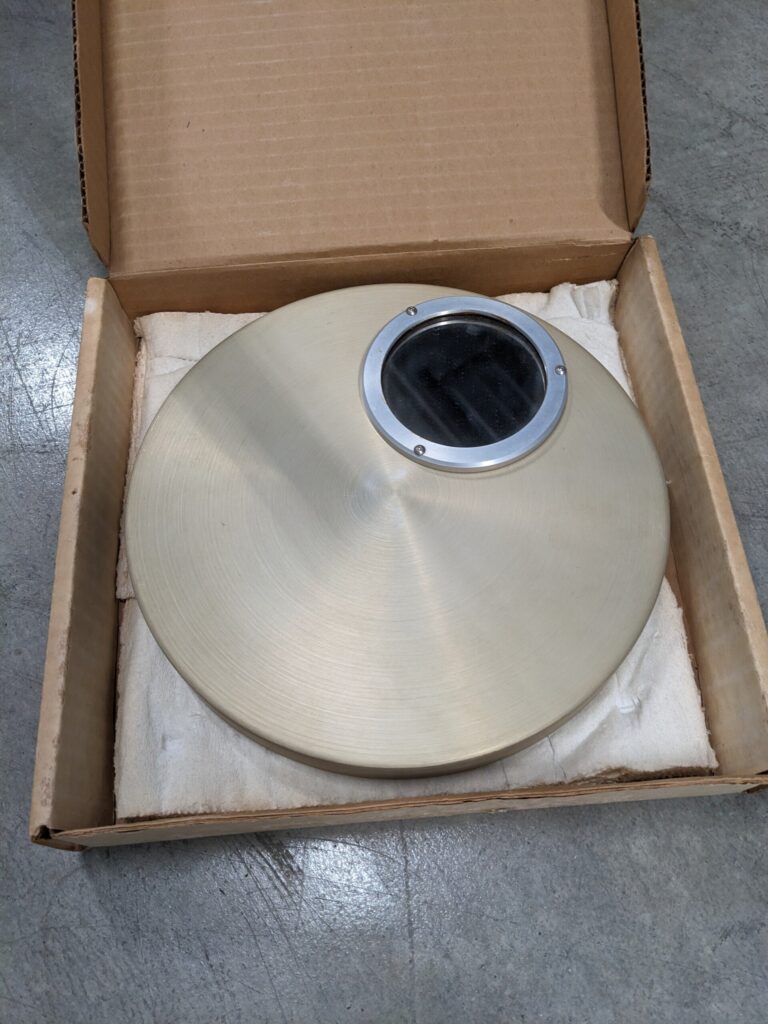
Glass off-axis Solar Filter for 8″ SCTs
This solar filter accessory slips over the front of an 8″ SCT. When in place, it allows you to observe the sun in full spectrum white light. Excellent for observing sunspots. If you want to see prominences and surface granulation, you need a Hydrogen Alpha telescope, such as SDAA-034 or SDAA-037.
SDAA-063
Celestron UHC/LPR filter (2″)
This 2″ Light Pollution Reduction (LPR) Filter is designed to selectively reduce the transmission of certain wavelengths of light, specifically those produced by artificial light. This includes mercury vapor, and both high and low pressure sodium vapor lights and the unwanted natural light caused by neutral oxygen emission in our atmosphere (i.e. sky glow).
This “UHC” LPR filter is still a broadband filter, but delivers higher contrast of emission nebulae than typical neodymium light pollution filters. The coatings enable the filter to achieve a high transmission of over 97% across the entire bandpass, with total blockage of prominent light pollution lines. This filter can help improve visibility of nebulae and galaxies from light polluted suburban skies. However, no filter is as good as driving out to a dark site.


SDAA-070
Orion UltraBlock UHC filter (2″)
The Orion UltraBlock filter is a narrowband filter designed to enhance the visibility of deep-sky objects, particularly in light-polluted skies. By blocking most artificial light wavelengths and isolating key emission lines, such as those from hydrogen-beta and oxygen-III, it improves contrast on nebulae and other faint celestial targets. This filter is ideal for urban astronomers and enhances views of objects like the Orion Nebula and the Lagoon Nebula. It is compatible with both visual observing and imaging setups.
SDAA-062
2″ 2x Barlow
Borrow this big 2x barlow to double the magnification from your 2″ eyepieces or cameras with 2″ nosepieces. Comes with a 1.25″ adapter.

SDAA-079
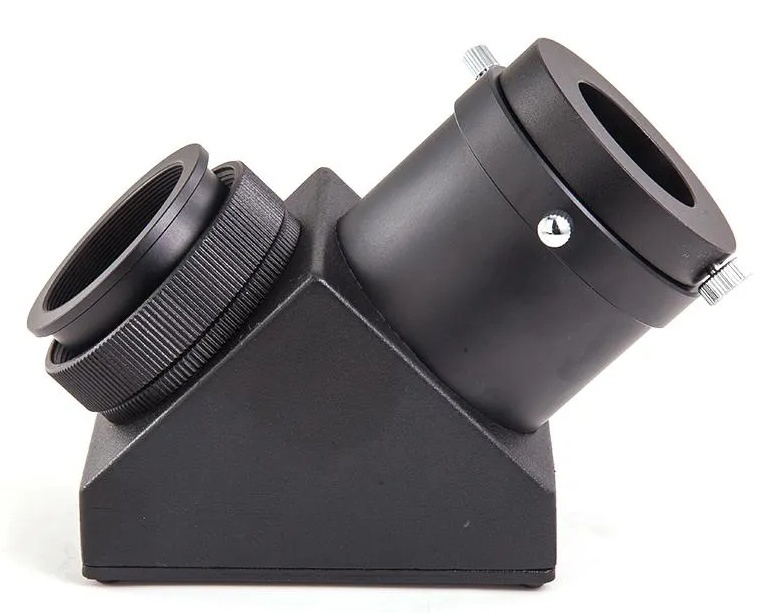
2″ Mirror Diagonal
This Celestron mirror diagonal includes both a standard 2″ barrel nosepiece as well as a threaded SCT nosepiece, so you can try out both styles. Also includes a 2″ SCT visual back. Try out some wide field 2″ eyepieces in your SCT or refractor. Includes 1.25″ adapter.
SDAA-105
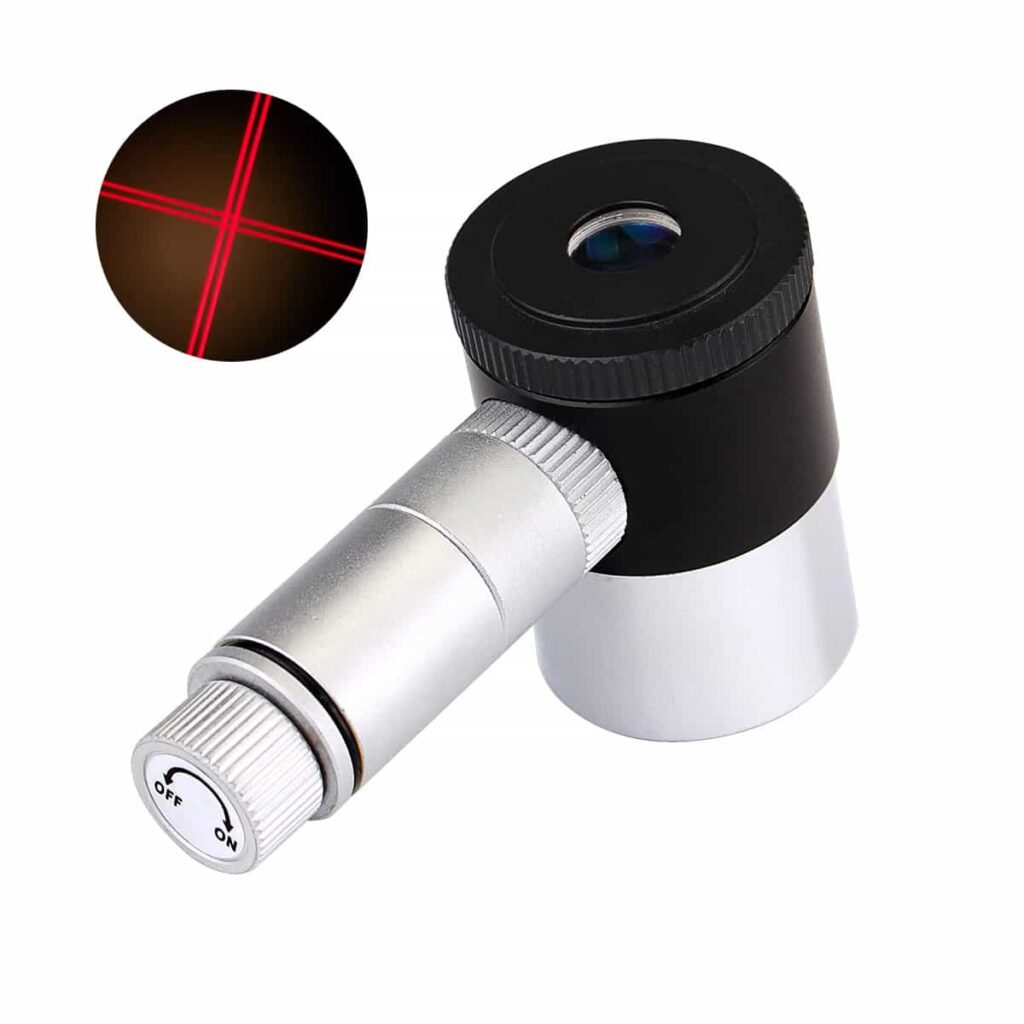
Orion 12.5mm Plossl w/illuminated reticle
When precise centering matters, you need an illuminated reticle eyepiece. Whether it’s for getting your mount’s pointing model perfectly calibrated, or performing star testing on your cassegrain (which requires precise centering of the defocused star), this tool is indispensable.
Coated Plossl optics at 12.5mm focal length. Double crosshair with adjustable illumination. Twist-up adjustable focus for the crosshairs.
SDAA-065, SDAA-066, SDAA-067
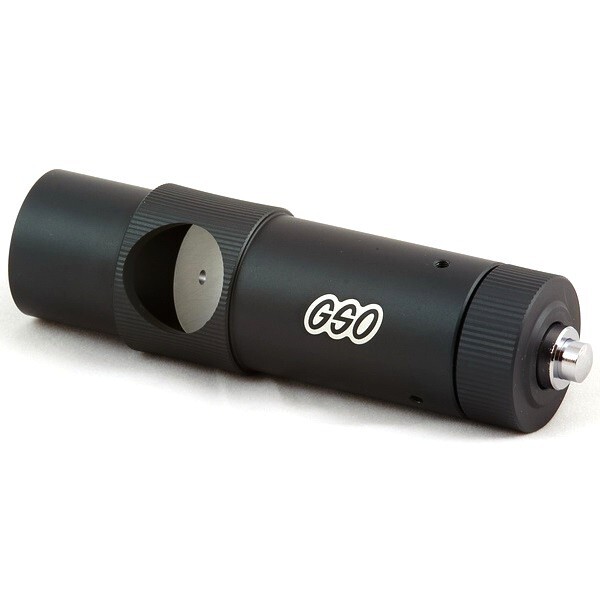
Laser Collimation Tool
Brands and styles vary. Borrow one of these laser collimation tools to make aligning the mirrors on your Newtonian reflector easy.
SDAA-096
Hotech SCT Collimator
This sophisticated laser collimation tool allows you to check and adjust the collimation of your Schmidt cassegrain, classical cassegrain, Ritchey-Chrétien, Dall-Kirkham, and many other types of cassegrain telescopes. Its proprietary system of quad lasers, precision machined reflector mirrors, and calibration scale, allows you to adjust all three key aspects of cassegrain telescopes: secondary centering on optical axis, secondary tilt (collimation), and camera/focuser/visual-back perpendicuity to optical axis.
You must be careful to use this collimator properly. Use at your own risk! Even tiny misalignments during setup can result in huge collimation errors (you can make things way worse!). Hotech provides good videos showing how to set up and use this device: Video #1, Video #2
Kit includes the Hotech laser collimator, 1.25″ and 2″ reflector mirrors, alt/az stage, tripod, and a Hubble Optics artificial star to finalize collimation.

SDAA-118
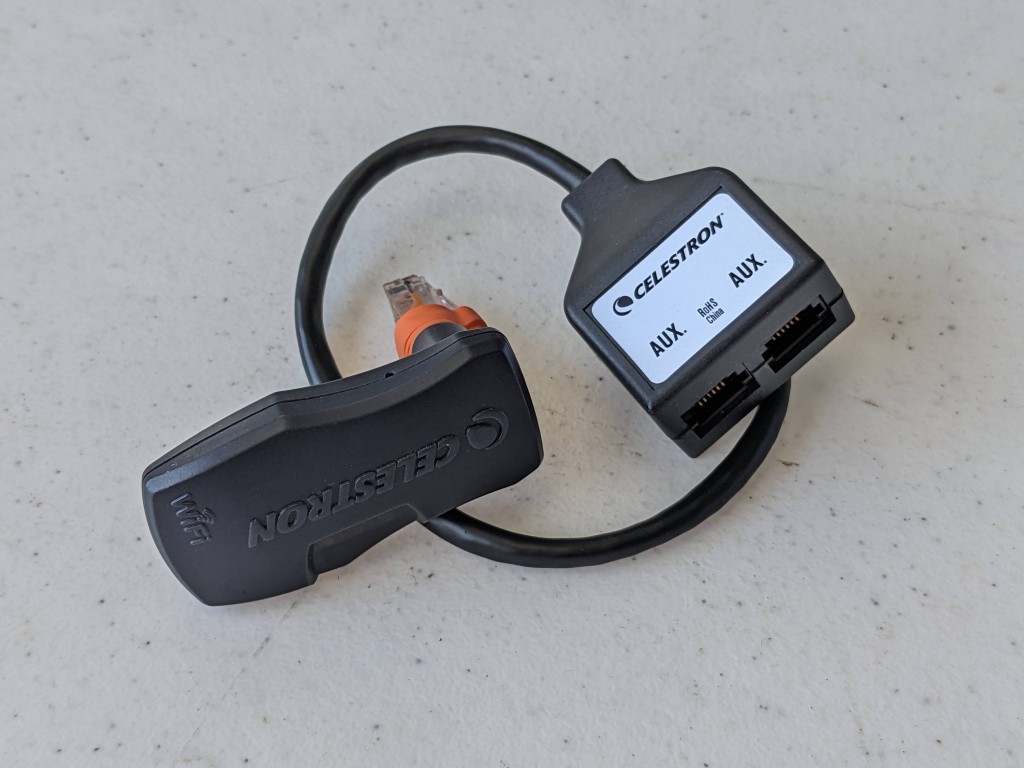
Celestron SkyPortal WiFi adapter + Aux splitter
This accessory allows you to control virtually any Celestron mount from your phone or tablet over a WiFi connection. Plug in the adapter to your mount’s AUX port (the splitter is available in case your AUX port is already in use by some other accessory) then install the free Celestron SkyPortal app to your phone or tablet. The app will walk you through pairing to the SkyPortal device on your telescope, then you can control the telescope using the app (which is powered by SkySafari).
Available as a standalone item for your own mount, or you can pair it with any of our loaner scopes riding on Celestron mounts.
SDAA-124
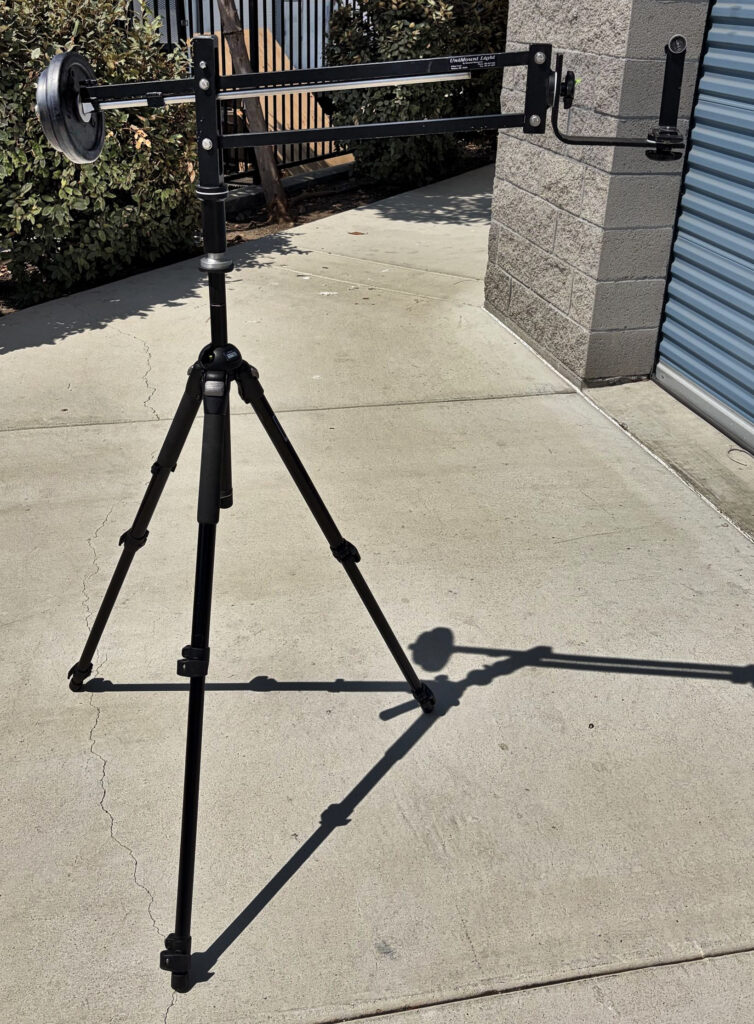
Binocular Parallelogram Mount
If you enjoy stargazing with your binoculars, you are probably frequently frustrated by the constant shaking from trying to use them handheld. Parallelogram mounts are designed to hold your binoculars steady, so you can see more detail and observe with less fatigue.
This parallelogram mount comes with everything in the photo: tripod, mount, and a pair of counterweights. Your binoculars mount to the attachment point on the right. Large tension knobs make it easy to get the binoculars pointed at the part of the sky you want to observe, and keep them pointed there.
Current Inventory Status
The table below shows the current status of the SDAA loaner inventory. The due date is not a gurantee that the equipment will be returned by that date: scheduling conflicts and inclement weather can often push return dates out, so do not count on equipment being returned by the due date. It is always best to contact the SDAA Loaner Equipment Coordinator to express your interest in an item, and to get on the waitlist if it is already checked out.